explaining how to write a quadratic function\nexplain how you could write a quadratic function in factored…
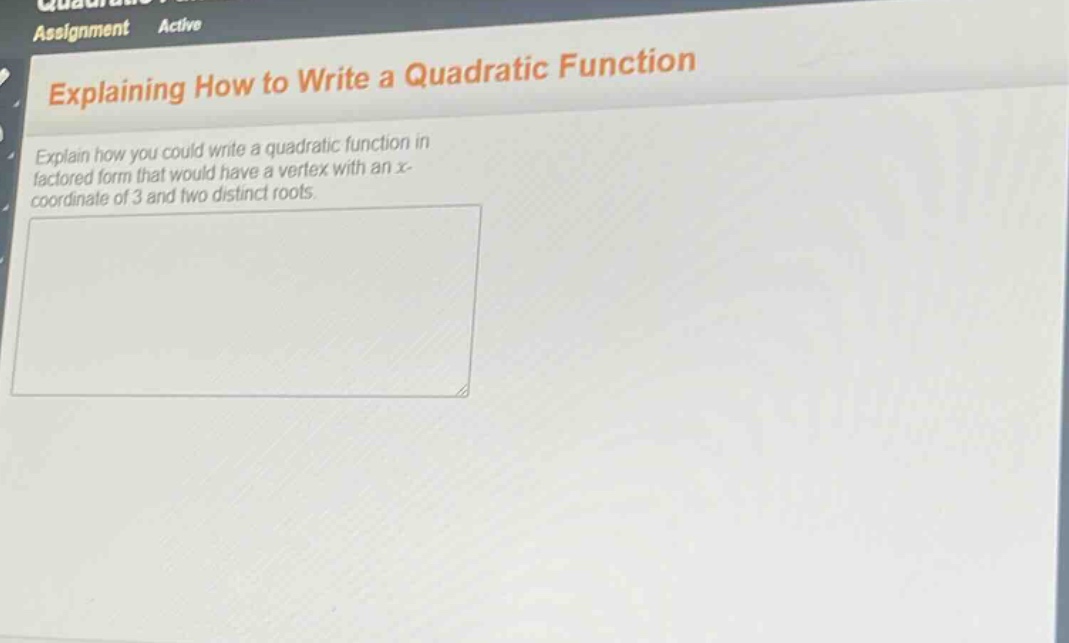
explaining how to write a quadratic function\nexplain how you could write a quadratic function in factored form that would have a vertex with an x - coordinate of 3 and two distinct roots.
Answer
Explanation:
Step1: Recall vertex - root relationship
The vertex of a quadratic function in factored form $y = a(x - r_1)(x - r_2)$ has an $x$ - coordinate given by $x=\frac{r_1 + r_2}{2}$. We know $x = 3$, so $\frac{r_1 + r_2}{2}=3$, which implies $r_1 + r_2=6$.
Step2: Choose distinct roots
We can choose any two distinct numbers $r_1$ and $r_2$ such that $r_1 + r_2 = 6$. For example, let $r_1=1$ and $r_2 = 5$.
Step3: Write the quadratic function
The quadratic function in factored form is $y=a(x - 1)(x - 5)$, where $a\neq0$. The value of $a$ can be any non - zero real number. It affects the shape and direction of the parabola. If $a>0$, the parabola opens upward, and if $a < 0$, the parabola opens downward.
Answer:
Choose two distinct numbers $r_1$ and $r_2$ such that $\frac{r_1 + r_2}{2}=3$ (e.g., $r_1 = 1$ and $r_2=5$), and write the quadratic function as $y=a(x - r_1)(x - r_2)$ where $a\neq0$ (e.g., $y=a(x - 1)(x - 5)$ for the chosen roots).