which explains whether △fgh is congruent to △fjh? they are congruent because (overline{gh}congoverline{gf},ov…
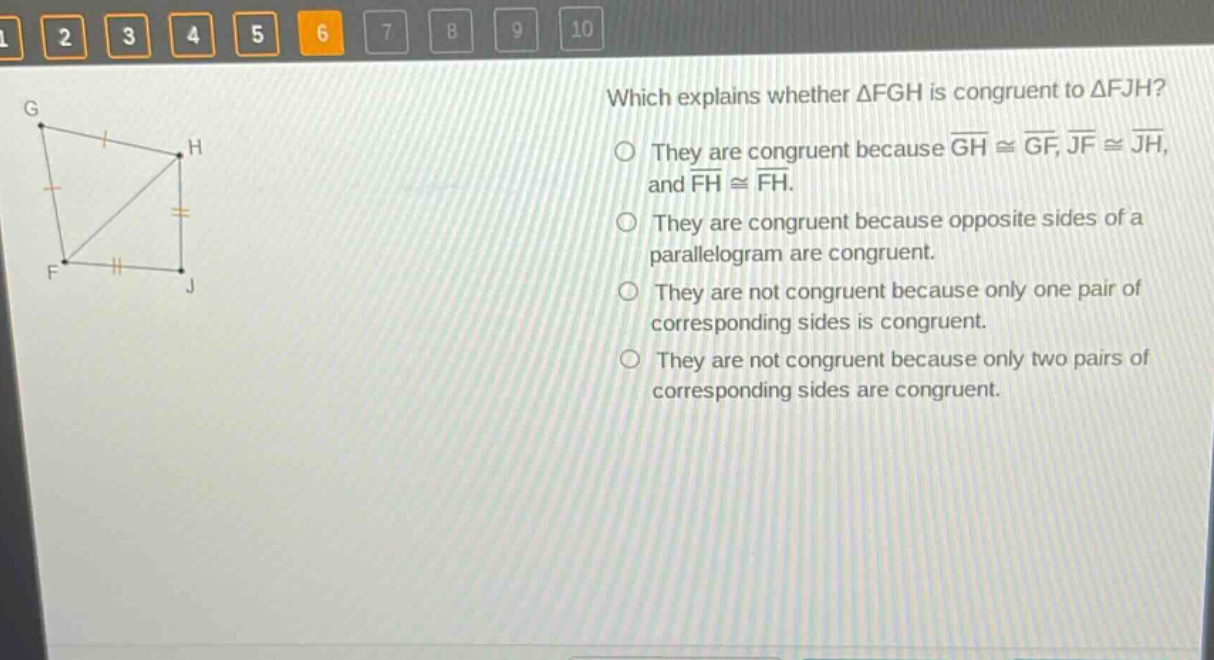
which explains whether △fgh is congruent to △fjh? they are congruent because (overline{gh}congoverline{gf},overline{jf}congoverline{jh},) and (overline{fh}congoverline{fh}). they are congruent because opposite sides of a parallelogram are congruent. they are not congruent because only one pair of corresponding sides is congruent. they are not congruent because only two pairs of corresponding sides are congruent.
Answer
Explanation:
Step1: Recall congruence criteria
For two triangles to be congruent, we need SSS (all three - side pairs congruent), SAS (two - side pairs and the included angle congruent), ASA (two - angle pairs and the included side congruent), AAS (two - angle pairs and a non - included side congruent), or HL (for right - triangles). In the given triangles $\triangle FGH$ and $\triangle FJH$, we are only given information about side lengths.
Step2: Analyze side - length congruence
We are not given enough side - length congruences to prove congruence. We need three pairs of congruent sides for SSS criterion. Here, we do not have enough information to say that all three pairs of corresponding sides are congruent. Just having one or two pairs of congruent sides is not sufficient.
Answer:
They are not congruent because only two pairs of corresponding sides are congruent.