exploration: click on sections 1 to 6 of the graph to explore key aspects of life and the environment on our…
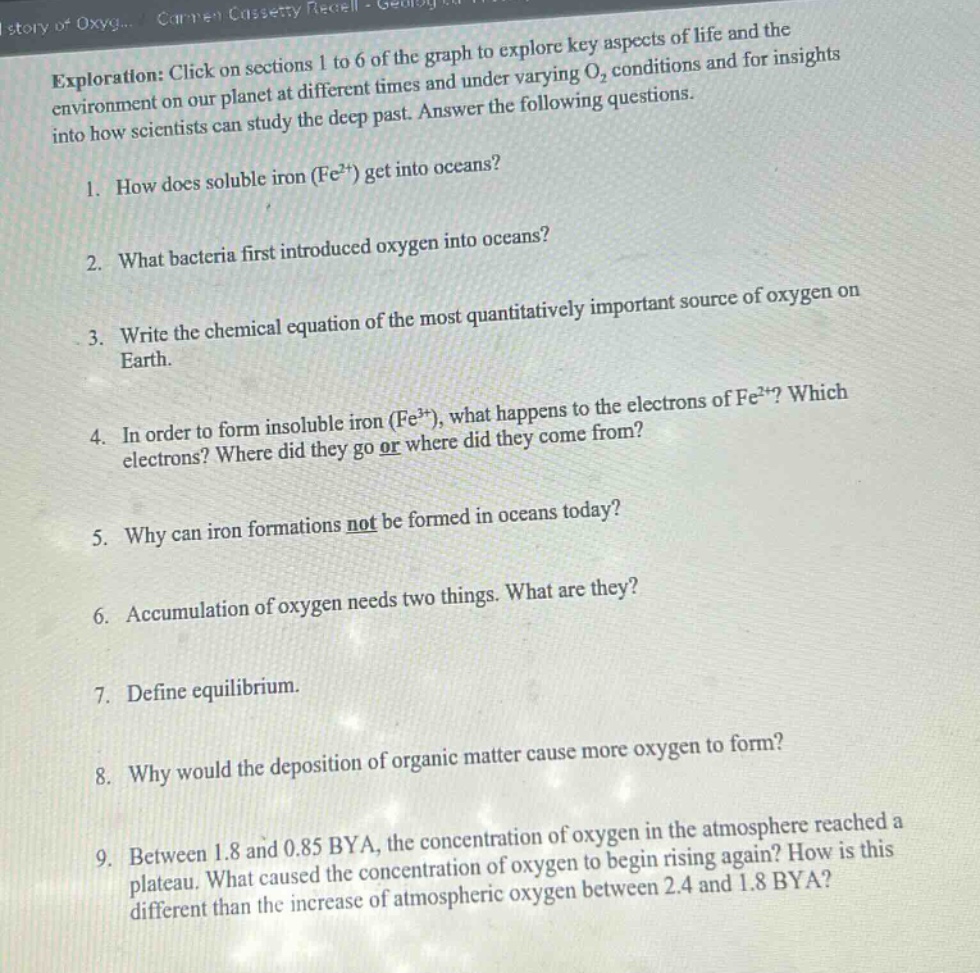
exploration: click on sections 1 to 6 of the graph to explore key aspects of life and the environment on our planet at different times and under varying o₂ conditions and for insights into how scientists can study the deep past. answer the following questions.\n1. how does soluble iron (fe²⁺) get into oceans?\n2. what bacteria first introduced oxygen into oceans?\n3. write the chemical equation of the most quantitatively important source of oxygen on earth.\n4. in order to form insoluble iron (fe³⁺), what happens to the electrons of fe²⁺? which electrons? where did they go or where did they come from?\n5. why can iron formations not be formed in oceans today?\n6. accumulation of oxygen needs two things. what are they?\n7. define equilibrium.\n8. why would the deposition of organic matter cause more oxygen to form?\n9. between 1.8 and 0.85 bya, the concentration of oxygen in the atmosphere reached a plateau. what caused the concentration of oxygen to begin rising again? how is this different than the increase of atmospheric oxygen between 2.4 and 1.8 bya?
Answer
Brief Explanations:
- Weathering of iron - containing rocks on land releases soluble iron ($Fe^{2 + }$) which is then carried by rivers into the oceans.
- Cyanobacteria were the first bacteria to introduce oxygen into oceans through photosynthesis.
- The most quantitatively important source of oxygen on Earth is photosynthesis, with the chemical equation $6CO_{2}+6H_{2}O\xrightarrow{light}C_{6}H_{12}O_{6} + 6O_{2}$.
- $Fe^{2+}$ loses an electron to form $Fe^{3+}$. The electron is transferred to an oxidizing agent, such as oxygen in the presence of water.
- Iron formations cannot be formed in oceans today because the current oxygen - rich environment rapidly oxidizes iron to its insoluble ferric form, preventing the large - scale precipitation of iron compounds as in the past.
- Accumulation of oxygen needs a source of oxygen (such as photosynthesis) and a sink for the reduced compounds that would otherwise react with the oxygen (e.g., burial of organic matter).
- Equilibrium is a state in which the forward and reverse reactions of a chemical or physical process occur at the same rate, resulting in no net change in the system.
- The deposition of organic matter removes carbon from the active carbon - oxygen cycle. When organic matter is buried, the oxygen that would have been used to oxidize it is left in the atmosphere or water, causing more oxygen to accumulate.
- After the oxygen concentration plateau between 1.8 and 0.85 BYA, the concentration began rising again due to the continued burial of organic matter and the evolution of more efficient photosynthetic organisms. Between 2.4 and 1.8 BYA, the increase was due to the initial rise of oxygen - producing cyanobacteria and the oxidation of reduced compounds in the oceans and on land.
Answer:
- Through weathering of iron - containing rocks on land and transport by rivers.
- Cyanobacteria.
- $6CO_{2}+6H_{2}O\xrightarrow{light}C_{6}H_{12}O_{6} + 6O_{2}$
- $Fe^{2+}$ loses an electron to an oxidizing agent like oxygen in water to form $Fe^{3+}$.
- Due to the oxygen - rich environment that rapidly oxidizes iron to insoluble ferric form.
- A source of oxygen (e.g., photosynthesis) and a sink for reduced compounds.
- A state where forward and reverse processes occur at the same rate with no net change.
- Because it removes carbon from the active carbon - oxygen cycle, leaving oxygen unreacted.
- Continued burial of organic matter and evolution of more efficient photosynthetic organisms; initial rise of cyanobacteria and oxidation of reduced compounds in the earlier period.