which is an exponential decay function?\n$\\circ\\ f(x)=\\frac{3}{4}(\\frac{7}{4})^x$\n$\\circ\\…
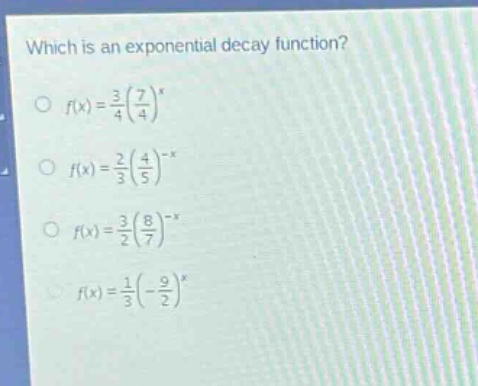
which is an exponential decay function?\n$\\circ\\ f(x)=\\frac{3}{4}(\\frac{7}{4})^x$\n$\\circ\\ f(x)=\\frac{2}{3}(\\frac{4}{5})^{-x}$\n$\\circ\\ f(x)=\\frac{3}{2}(\\frac{8}{7})^{-x}$\n$\\circ\\ f(x)=\\frac{1}{3}(-\\frac{9}{2})^x$
Answer
Explanation:
Step1: Recall exponential - decay form
The general form of an exponential function is $y = a\cdot b^{x}$, where $a\neq0$, $b > 0$, and $b\neq1$. For an exponential decay function, $0 < b<1$. If the function is in the form $y = a\cdot b^{-x}=a\cdot(\frac{1}{b})^{x}$, then for decay, $\frac{1}{b}>1$ or $b < 1$.
Step2: Analyze each option
- Option 1: For $f(x)=\frac{3}{4}(\frac{7}{4})^{x}$, here $b = \frac{7}{4}>1$, so it is an exponential growth function.
- Option 2: Rewrite $f(x)=\frac{2}{3}(\frac{4}{5})^{-x}=\frac{2}{3}(\frac{5}{4})^{x}$. Since $b=\frac{5}{4}>1$, it is an exponential growth function.
- Option 3: Rewrite $f(x)=\frac{3}{2}(\frac{8}{7})^{-x}=\frac{3}{2}(\frac{7}{8})^{x}$. Here $b = \frac{7}{8}$, and $0<\frac{7}{8}<1$, so it is an exponential decay function.
- Option 4: For $f(x)=\frac{1}{3}(-\frac{9}{2})^{x}$, since $b =-\frac{9}{2}<0$, it is not an exponential function (the base of an exponential function $y = a\cdot b^{x}$ must be positive, $b>0$).
Answer:
$f(x)=\frac{3}{2}(\frac{8}{7})^{-x}$