which exponential function is represented by the graph?\n○ (f(x)=2(\frac{1}{2})^x)\n○ (f(x)=\frac{1}{2}(2)^x)…
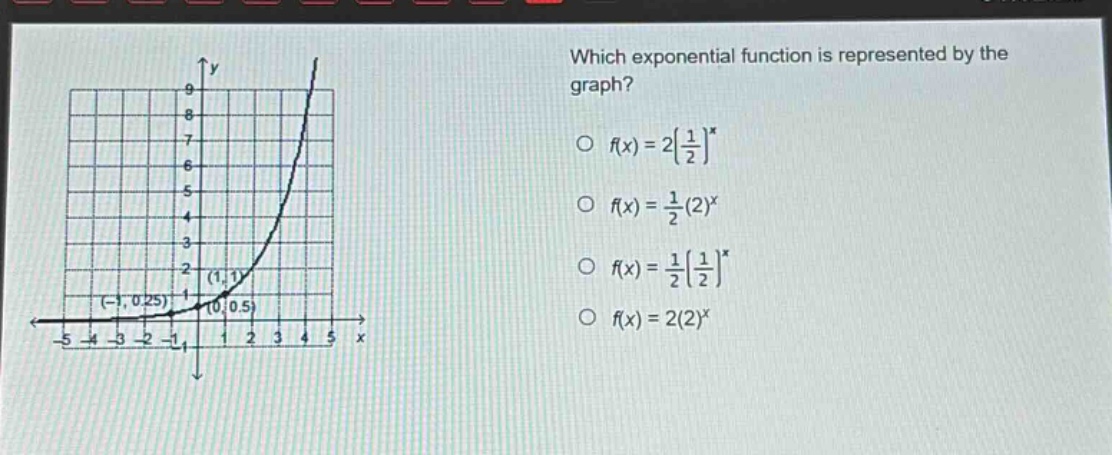
which exponential function is represented by the graph?\n○ (f(x)=2(\frac{1}{2})^x)\n○ (f(x)=\frac{1}{2}(2)^x)\n○ (f(x)=\frac{1}{2}(\frac{1}{2})^x)\n○ (f(x)=2(2)^x)
Answer
Explanation:
Step1: Recall the general form of exponential function
The general form of an exponential function is $f(x)=ab^{x}$, where $a$ is the y - intercept (value of $y$ when $x = 0$) and $b$ is the base.
Step2: Find the y - intercept from the graph
When $x = 0$, the graph passes through the point $(0,0.5)$. Substituting $x = 0$ into $f(x)=ab^{x}$, we get $f(0)=a\cdot b^{0}=a$. So $a = 0.5=\frac{1}{2}$.
Step3: Use another point to find the base $b$
The graph passes through the point $(1,1)$. Substitute $x = 1$, $y = 1$ and $a=\frac{1}{2}$ into $y = ab^{x}$. We have $1=\frac{1}{2}\cdot b^{1}$. Solving for $b$ gives $b = 2$.
Step4: Write the exponential function
The exponential function is $f(x)=\frac{1}{2}(2)^{x}$.
Answer:
$f(x)=\frac{1}{2}(2)^{x}$