which is an exponential growth function?\n$f(x)=6(0.25)^x$\n$f(x)=0.25(5.25)^x$\n$f(x)= - 4.25^x$\n$f(x)=(-1…
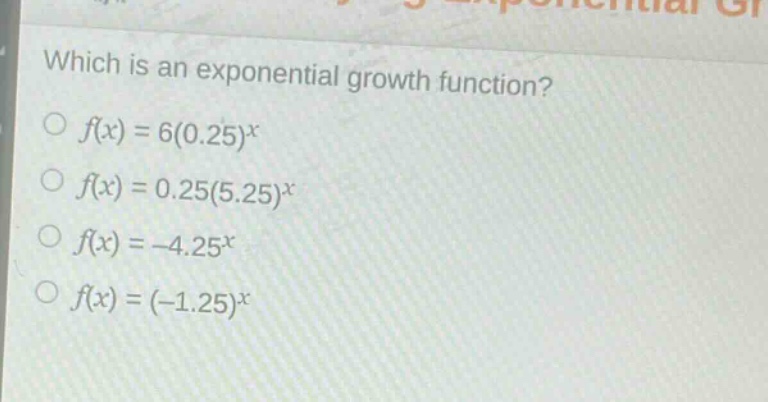
which is an exponential growth function?\n$f(x)=6(0.25)^x$\n$f(x)=0.25(5.25)^x$\n$f(x)= - 4.25^x$\n$f(x)=(-1.25)^x$
Answer
Explanation:
Step1: Recall exponential - growth function form
The general form of an exponential function is $f(x)=a\cdot b^{x}$, where $a\neq0$, $b > 0$, and for exponential growth, $b>1$.
Step2: Analyze each option
- For $f(x)=6(0.25)^{x}$, here $a = 6$ and $b=0.25<1$, so it is an exponential - decay function.
- For $f(x)=0.25(5.25)^{x}$, $a = 0.25$ and $b = 5.25>1$, so it is an exponential - growth function.
- For $f(x)=-4.25^{x}$, the base $b = 4.25>1$, but the coefficient $a=-1$, and the form of an exponential function requires $a\neq0$ and the base $b>0$ and the function should be written as $f(x)=a\cdot b^{x}$, this is not in the correct form of an exponential function.
- For $f(x)=(-1.25)^{x}$, the base $b=-1.25<0$, and for an exponential function $y = a\cdot b^{x}$, $b>0$.
Answer:
$f(x)=0.25(5.25)^{x}$