an exponential growth function has an asymptote of y = - 3. which might have occurred in the original…
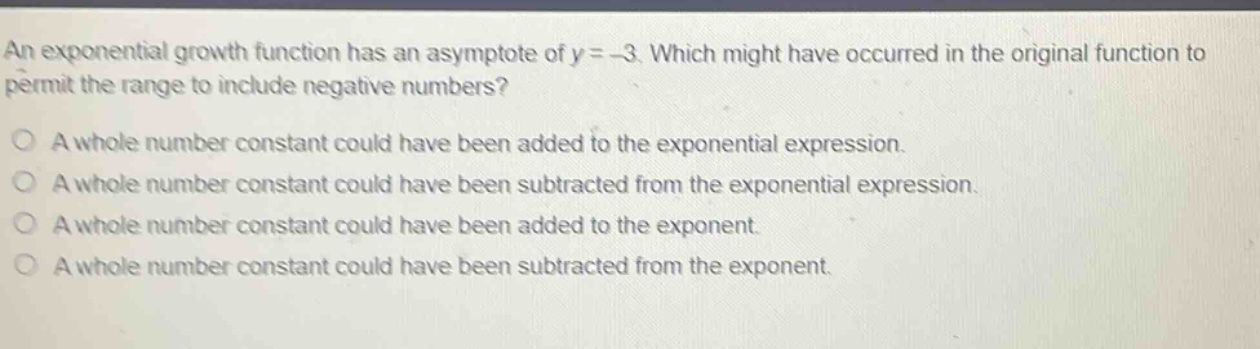
an exponential growth function has an asymptote of y = - 3. which might have occurred in the original function to permit the range to include negative numbers?\na whole number constant could have been added to the exponential expression.\na whole number constant could have been subtracted from the exponential expression.\na whole number constant could have been added to the exponent.\na whole number constant could have been subtracted from the exponent.
Answer
Brief Explanations:
The general form of an exponential function is $y = a\cdot b^{x}+k$, where $y = k$ is the horizontal - asymptote. If the asymptote is $y=-3$, the function is of the form $y = a\cdot b^{x}-3$. Adding or subtracting a constant to/from the exponent ($x$) changes the $x$ - values for which the function is evaluated but does not directly affect the range in terms of allowing negative values. Adding or subtracting a constant to the exponential expression $b^{x}$ also does not directly relate to the range including negative values in the context of the asymptote. However, when we consider the form of the exponential function with a vertical shift, if we start with a basic exponential function $y = a\cdot b^{x}$ (range is $(0,\infty)$ for $a>0$ and $b > 1$ or $(0,-\infty)$ for $a<0$ and $b>1$) and we want the range to include negative numbers and have an asymptote of $y = - 3$, we can think of it in terms of vertical shifts. A vertical shift of the form $y=a\cdot b^{x}+k$ where $k=-3$ allows for the range to include negative values. This is equivalent to adding or subtracting a constant from the whole exponential expression.
Answer:
A. A whole number constant could have been added to the exponential expression.