which expression demonstrates the use of the commutative property of addition in the first step of…
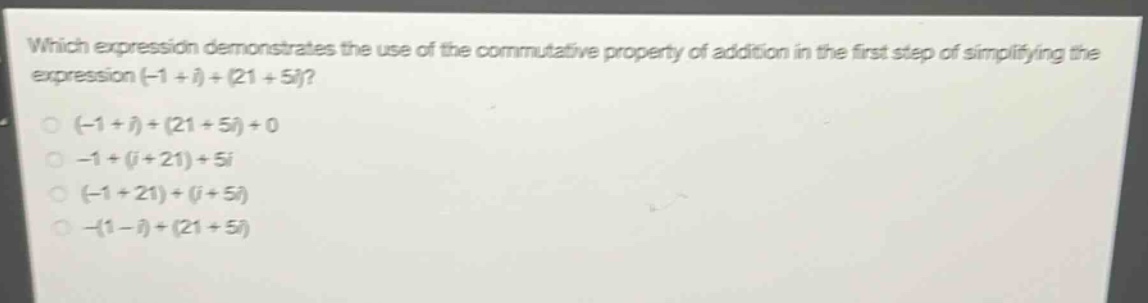
which expression demonstrates the use of the commutative property of addition in the first step of simplifying the expression (-1 + i) + (21 + 5i)?\n(-1 + i) + (21 + 5i) + 0\n-1 + (i + 21) + 5i\n(-1 + 21) + (i + 5i)\n-(1 - i) + (21 + 5i)
Answer
Explanation:
Step1: Recall commutative property
The commutative property of addition for real - numbers (a) and (b) is (a + b=b + a), and for complex numbers (z_1=a_1 + b_1i) and (z_2=a_2 + b_2i), (z_1+z_2=z_2 + z_1). Given ((-1 + i)+(21 + 5i)), we can swap the real - part and real - part, and the imaginary - part and imaginary - part.
Step2: Apply to complex numbers
We rewrite ((-1 + i)+(21 + 5i)) as ((-1+21)+(i + 5i)) by using the commutative property of addition to re - arrange the real parts (-1) and (21), and the imaginary parts (i) and (5i).
Answer:
C. ((-1 + 21)+(i + 5i))