the expression \\(\\frac{\\log \\frac{1}{3}}{\\log 2}\\) is the result of applying the change of base…
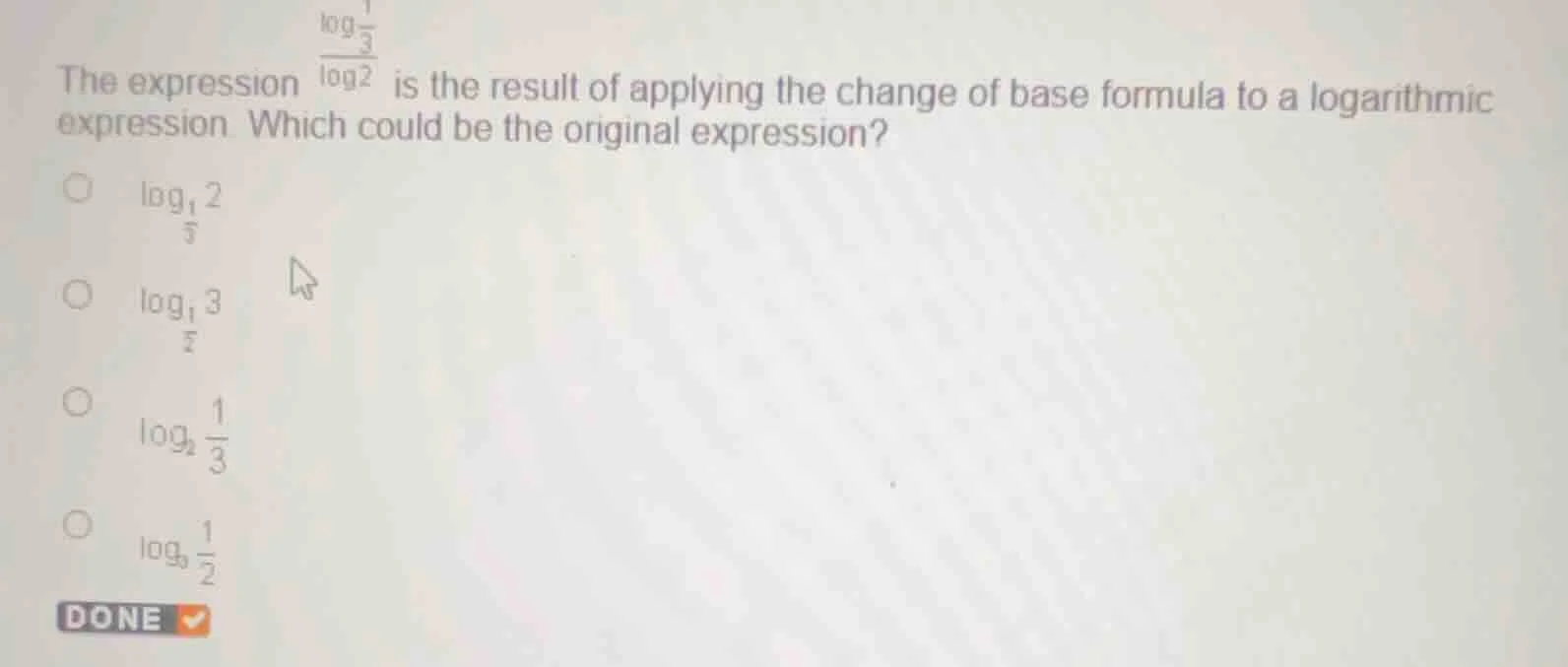
the expression \\(\\frac{\\log \\frac{1}{3}}{\\log 2}\\) is the result of applying the change of base formula to a logarithmic expression. which could be the original expression?\n\\(\\bigcirc\\) \\(\\log_{\\frac{1}{5}} 2\\)\n\\(\\bigcirc\\) \\(\\log_{\\frac{1}{2}} 3\\)\n\\(\\bigcirc\\) \\(\\log_{2} \\frac{1}{3}\\)\n\\(\\bigcirc\\) \\(\\log_{9} \\frac{1}{2}\\)
Answer
Explanation:
Step1: Recall Change of Base Formula
The change of base formula for logarithms is $\log_b a = \frac{\log_c a}{\log_c b}$, where $c>0$, $c\neq1$, $b>0$, $b\neq1$, and $a>0$.
Step2: Analyze the Given Expression
The given expression is $\frac{\log \frac{1}{3}}{\log 2}$. Let's compare it with the change of base formula. Here, the numerator is $\log \frac{1}{3}$ (which is $\log_c \frac{1}{3}$) and the denominator is $\log 2$ (which is $\log_c 2$) for some base $c$ (usually base 10 or base $e$, but the base doesn't matter for the form). So, using the change of base formula, this should be equal to $\log_2 \frac{1}{3}$, because if we have $\frac{\log_c \frac{1}{3}}{\log_c 2}$, by the change of base formula, that's $\log_2 \frac{1}{3}$ (since $a = \frac{1}{3}$, $b = 2$ in the formula $\log_b a=\frac{\log_c a}{\log_c b}$).
Let's check the options:
- Option 1: $\log_{\frac{1}{5}} 2$ would use the change of base formula as $\frac{\log 2}{\log \frac{1}{5}}$, not matching.
- Option 2: $\log_{\frac{1}{2}} 3$ would be $\frac{\log 3}{\log \frac{1}{2}}$, not matching.
- Option 3: $\log_2 \frac{1}{3}$ matches our derived original expression from the change of base formula.
- Option 4: $\log_9 \frac{1}{2}$ would be $\frac{\log \frac{1}{2}}{\log 9}$, not matching.
Answer:
C. $\log_{2} \frac{1}{3}$ (assuming the third option is labeled as C, with the text $\log_{2} \frac{1}{3}$)