which expression is a perfect cube?\n-1,452m^{18}n^{15}p^{22}\n-1,331m^{18}n^{15}p^{21}\n1,331m^{18}n^{15}p^{…
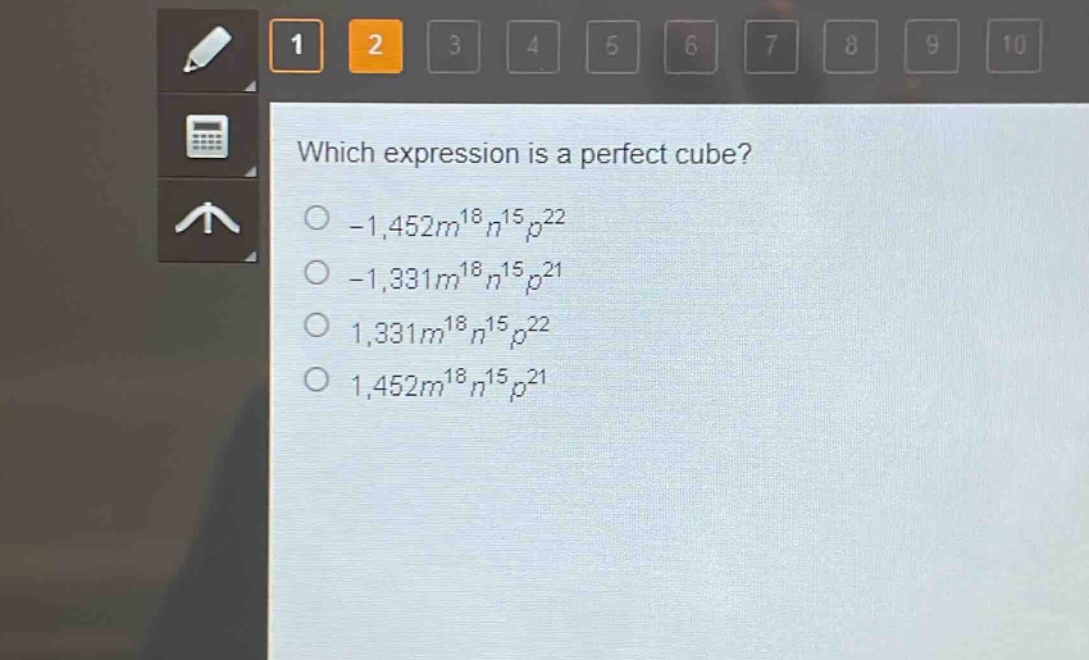
which expression is a perfect cube?\n-1,452m^{18}n^{15}p^{22}\n-1,331m^{18}n^{15}p^{21}\n1,331m^{18}n^{15}p^{22}\n1,452m^{18}n^{15}p^{21}
Answer
Explanation:
Step1: Analyze the coefficient
Check if the coefficient is a perfect - cube. For (-1331), since ((- 11)^3=-1331), and (1331 = 11^3). For (1452), (1452=2^2\times3\times11^2) is not a perfect cube.
Step2: Analyze the exponents of variables
Use the rule ((a^m)^n=a^{mn}). For a term (a^k) to be a perfect cube, (k) must be divisible by (3).
- For (m^{18}), since (18\div3 = 6), (m^{18}=(m^6)^3).
- For (n^{15}), since (15\div3=5), (n^{15}=(n^5)^3).
- For (p^{21}), since (21\div3 = 7), (p^{21}=(p^7)^3). For (p^{22}), (22\div3=\frac{22}{3}) (not an integer).
Now check each option:
- Option 1: (-1452m^{18}n^{15}p^{22}), coefficient (1452) is not a perfect cube and (p^{22}) (exponent not divisible by (3)).
- Option 2: (-1331m^{18}n^{15}p^{21}=(-11m^6n^5p^7)^3)
- Option 3: (1331m^{18}n^{15}p^{22}), (p^{22}) (exponent not divisible by (3)).
- Option 4: (1452m^{18}n^{15}p^{21}), coefficient (1452) is not a perfect cube.
Answer:
(-1331m^{18}n^{15}p^{21}) (the second option)