which expression is a sum of cubes?\n-24a^{15}+125b^{18}\n-64a^{27}+b^{8}\n27x^{9}+y^{6}\n81x^{24}+8y^{40}
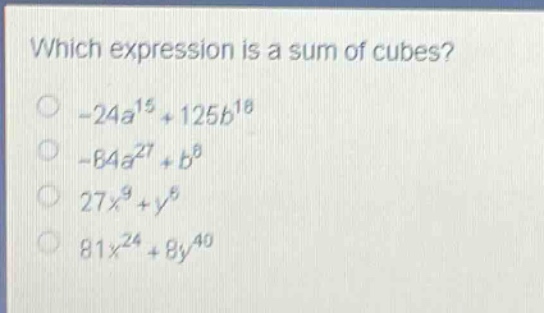
which expression is a sum of cubes?\n-24a^{15}+125b^{18}\n-64a^{27}+b^{8}\n27x^{9}+y^{6}\n81x^{24}+8y^{40}
Answer
Explanation:
Step1: Record the sum - of - cubes formula
The sum - of - cubes formula is (a^{3}+b^{3}=(a + b)(a^{2}-ab + b^{2})). We need to check each option to see if it can be written in the form (x^{3}+y^{3}).
Step2: Analyze the first option (-24a^{15}+125b^{18})
(-24a^{15}) is not a perfect cube since (24) is not a perfect cube ((24=2^{3}\times3)), so this option is incorrect.
Step3: Analyze the second option (-64a^{27}+b^{8})
(b^{8}=(b^{\frac{8}{3}})^{3}) is not an integer - exponent cube and (-64a^{27}=(-4a^{9})^{3}), but the form is not a sum of two perfect - integer - exponent cubes, so this option is incorrect.
Step4: Analyze the third option (27x^{9}+y^{6})
We know that (27x^{9}=(3x^{3})^{3}) and (y^{6}=(y^{2})^{3}). So, (27x^{9}+y^{6}=(3x^{3})^{3}+(y^{2})^{3}), which is in the form of a sum of cubes.
Step5: Analyze the fourth option (81x^{24}+8y^{40})
(81x^{24}=(3x^{8})^{3}\times3), (81) is not a perfect cube, so this option is incorrect.
Answer:
(27x^{9}+y^{6})