which expression is a sum of cubes?\n-64x^6y^12 + 125x^16y^3\n-32x^6y^12 + 125x^16y^3\n32x^6y^12 +…
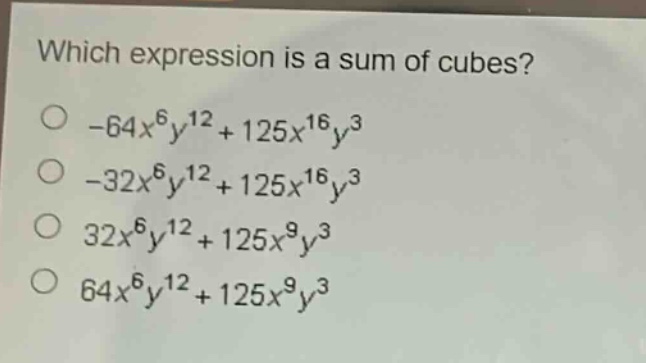
which expression is a sum of cubes?\n-64x^6y^12 + 125x^16y^3\n-32x^6y^12 + 125x^16y^3\n32x^6y^12 + 125x^9y^3\n64x^6y^12 + 125x^9y^3
Answer
Answer:
-64x^{6}y^{12}+125x^{16}y^{3}
Explanation:
Step1: Recall sum - of - cubes form
The sum of cubes formula is (a^{3}+b^{3}=(a + b)(a^{2}-ab + b^{2})). We need to check if each term in the expressions can be written as a cube.
Step2: Analyze first option
For (-64x^{6}y^{12}+125x^{16}y^{3}), (-64x^{6}y^{12}=(-4x^{2}y^{4})^{3}) and (125x^{16}y^{3}=(5x^{5}y)^{3}).
Step3: Analyze second option
For (-32x^{6}y^{12}), (\sqrt[3]{-32x^{6}y^{12}}=-2\sqrt[3]{4}x^{2}y^{4}), so it is not a perfect - cube.
Step4: Analyze third option
For (32x^{6}y^{12}), (\sqrt[3]{32x^{6}y^{12}} = 2\sqrt[3]{4}x^{2}y^{4}), so it is not a perfect - cube.
Step5: Analyze fourth option
For (64x^{6}y^{12}=(4x^{2}y^{4})^{3}), but for (125x^{9}y^{3}=(5x^{3}y)^{3}), the exponents of (x) in the two - term expression do not match the requirements for a sum of cubes in a consistent way as in the first option.