∠fbc and ∠cbg are supplements, ∠dbg and ∠dbf are supplements, and ∠cbg ≅ ∠dbf. by the congruent supplements…
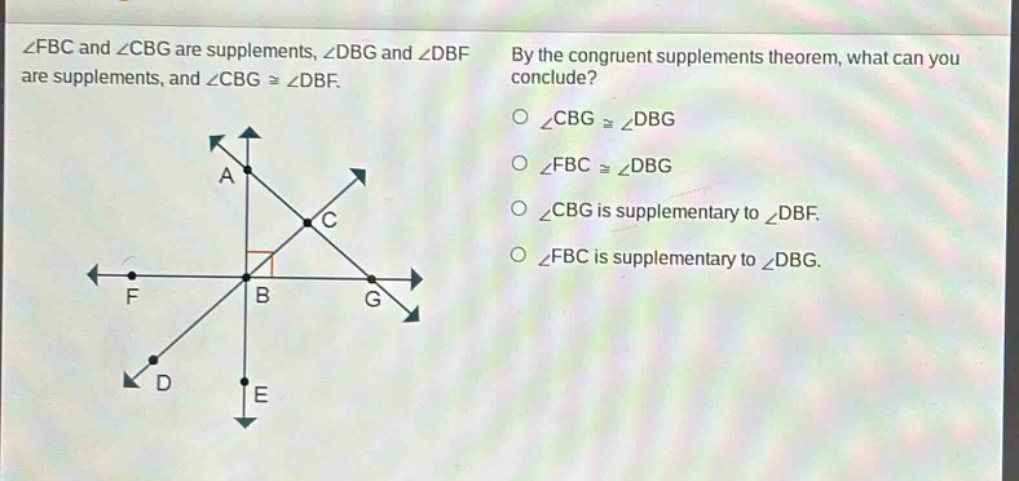
∠fbc and ∠cbg are supplements, ∠dbg and ∠dbf are supplements, and ∠cbg ≅ ∠dbf. by the congruent supplements theorem, what can you conclude? ∠cbg ≅ ∠dbg ∠fbc ≅ ∠dbg ∠cbg is supplementary to ∠dbf. ∠fbc is supplementary to ∠dbg.
Answer
Answer:
B. $\angle FBC\cong\angle DBG$
Explanation:
Step1: Recall congruent - supplements theorem
If two angles are supplements of congruent angles, then they are congruent.
Step2: Identify given supplementary and congruent angles
Given $\angle FBC$ and $\angle CBG$ are supplements ($\angle FBC+\angle CBG = 180^{\circ}$), $\angle DBG$ and $\angle DBF$ are supplements ($\angle DBG+\angle DBF=180^{\circ}$), and $\angle CBG\cong\angle DBF$.
Step3: Apply the theorem
By the congruent - supplements theorem, since $\angle FBC$ and $\angle DBG$ are supplements of congruent angles ($\angle CBG$ and $\angle DBF$ respectively), we can conclude that $\angle FBC\cong\angle DBG$.