figure abcd is a dilation of figure abcd about point e with a scale factor of 1.25. li says the figures are…
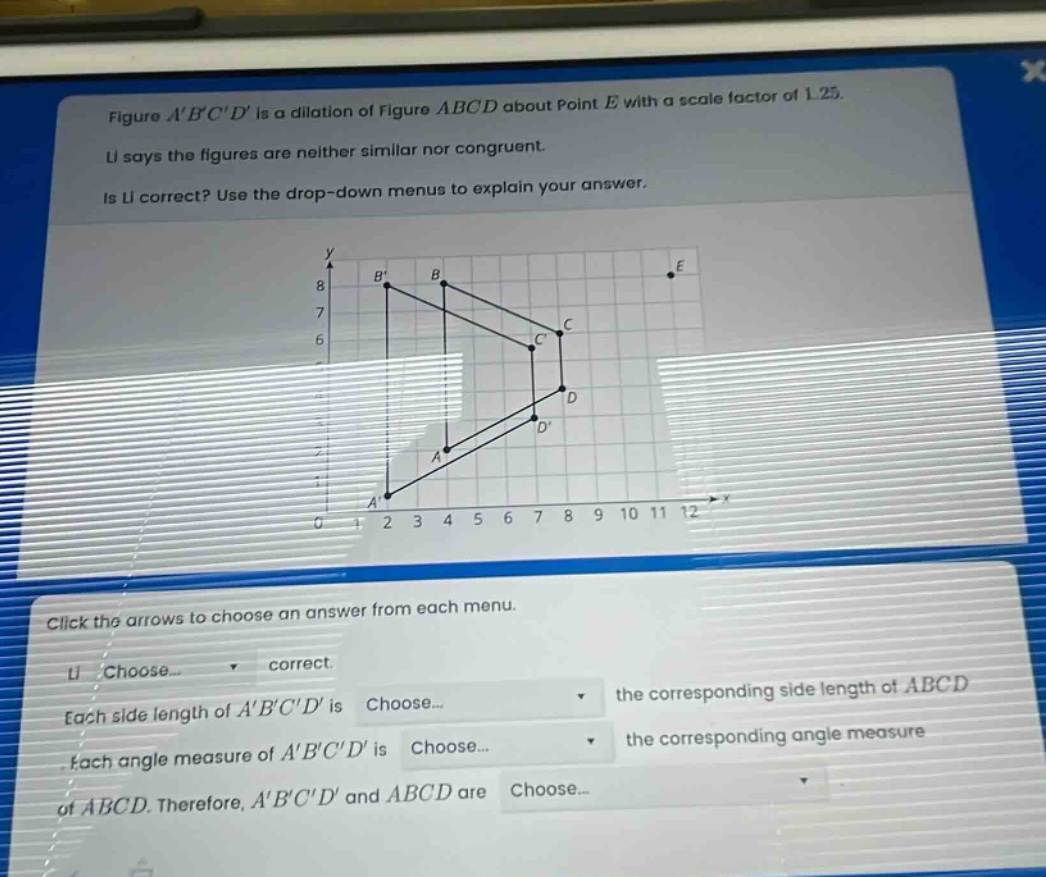
figure abcd is a dilation of figure abcd about point e with a scale factor of 1.25. li says the figures are neither similar nor congruent. is li correct? use the drop - down menus to explain your answer. click the arrows to choose an answer from each menu. li choose... correct. each side length of abcd is choose... the corresponding side length of abcd. each angle measure of abcd is choose... the corresponding angle measure of abcd. therefore, abcd and abcd are choose...
Answer
Explanation:
Step1: Recall dilation properties
A dilation with a scale - factor (k\neq1) changes the side - lengths. If the scale factor (k = 1.25), the side - lengths of the dilated figure (A'B'C'D') are (k = 1.25) times the side - lengths of the original figure (ABCD).
Step2: Recall angle - measure property in dilation
In a dilation, the angle measures remain the same. That is, corresponding angles of the original figure and the dilated figure are congruent.
Step3: Determine similarity and congruence
Two figures are similar if their corresponding angles are congruent and the ratios of their corresponding side - lengths are equal. Since the side - lengths of (A'B'C'D') are 1.25 times the side - lengths of (ABCD) and the corresponding angles are congruent, the figures are similar. They are not congruent because the side - lengths are not equal (scale factor (k = 1.25\neq1)).
Answer:
Li is not correct. Each side length of (A'B'C'D') is 1.25 times the corresponding side length of (ABCD). Each angle measure of (A'B'C'D') is equal to the corresponding angle measure of (ABCD). Therefore, (A'B'C'D') and (ABCD) are similar.