the figure below can be used to prove the pythagorean theorem. use the drop - down menus to complete the…
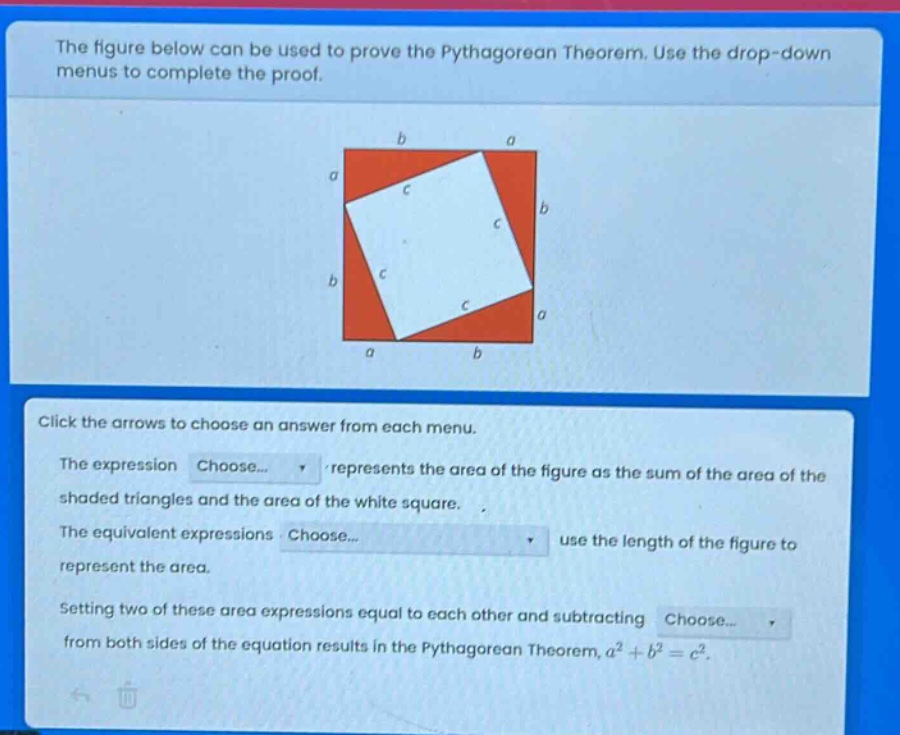
the figure below can be used to prove the pythagorean theorem. use the drop - down menus to complete the proof. click the arrows to choose an answer from each menu. the expression choose... represents the area of the figure as the sum of the area of the shaded triangles and the area of the white square. the equivalent expressions choose... use the length of the figure to represent the area. setting two of these area expressions equal to each other and subtracting choose... from both sides of the equation results in the pythagorean theorem, $a^{2}+b^{2}=c^{2}$.
Answer
Explanation:
Step1: Calculate area of shaded triangles and white - square
The area of each right - triangle is $\frac{1}{2}ab$. There are 4 right - triangles, so the total area of the 4 right - triangles is $4\times\frac{1}{2}ab = 2ab$. The area of the white square is $c^{2}$. So the sum of the area of the shaded triangles and the area of the white square is $2ab + c^{2}$.
Step2: Calculate area of the large square
The side - length of the large square is $a + b$. So the area of the large square is $(a + b)^{2}=a^{2}+2ab + b^{2}$ using the formula $(x + y)^{2}=x^{2}+2xy + y^{2}$ where $x = a$ and $y = b$.
Step3: Derive the Pythagorean theorem
Set $2ab + c^{2}=a^{2}+2ab + b^{2}$. Subtract $2ab$ from both sides of the equation. We get $a^{2}+b^{2}=c^{2}$.
Answer:
The first drop - down: $2ab + c^{2}$ The second drop - down: $(a + b)^{2}$ The third drop - down: $2ab$