find the angle between the following two vectors: $vec{a}=(-3, - 2)$ and $vec{b}=(4,4)$ (round your answer…
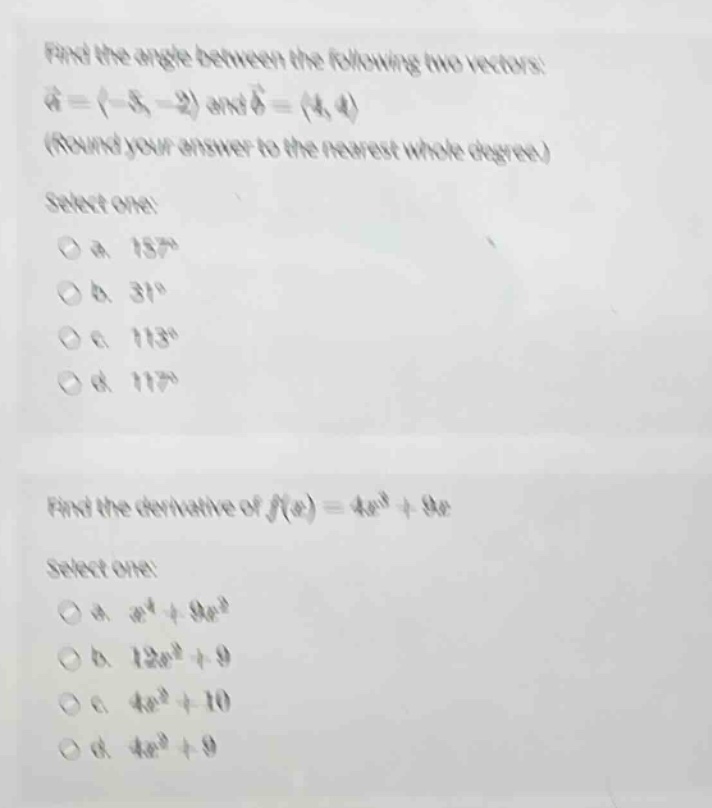
find the angle between the following two vectors: $vec{a}=(-3, - 2)$ and $vec{b}=(4,4)$ (round your answer to the nearest whole degree) select one: a. $18^{circ}$ b. $31^{circ}$ c. $113^{circ}$ d. $117^{circ}$ find the derivative of $f(x)=4x^{3}+9x$ select one: a. $x^{4}+9x^{2}$ b. $12x^{2}+9$ c. $4x^{2}+10$ d. $4x^{3}+9$
Answer
Answer:
- C. $113^{\circ}$
- B. $12x^{2}+9$
Explanation:
1. Finding the angle between two vectors
Step1: Recall the dot - product formula
The dot - product formula is $\vec{a}\cdot\vec{b}=\vert\vec{a}\vert\vert\vec{b}\vert\cos\theta$, where $\vec{a}=(- 3,-2)$ and $\vec{b}=(4,4)$, $\theta$ is the angle between the two vectors. First, calculate the dot - product: $\vec{a}\cdot\vec{b}=(-3)\times4+(-2)\times4=-12 - 8=-20$.
Step2: Calculate the magnitudes of the vectors
$\vert\vec{a}\vert=\sqrt{(-3)^{2}+(-2)^{2}}=\sqrt{9 + 4}=\sqrt{13}$, $\vert\vec{b}\vert=\sqrt{4^{2}+4^{2}}=\sqrt{16 + 16}=\sqrt{32}=4\sqrt{2}$.
Step3: Solve for $\cos\theta$
$\cos\theta=\frac{\vec{a}\cdot\vec{b}}{\vert\vec{a}\vert\vert\vec{b}\vert}=\frac{-20}{\sqrt{13}\times4\sqrt{2}}=\frac{-20}{4\sqrt{26}}=\frac{-5}{\sqrt{26}}\approx - 0.97$. Then $\theta=\cos^{-1}(-0.97)\approx113^{\circ}$.
2. Finding the derivative of the function
Step1: Apply the power rule
The power rule states that if $y = ax^{n}$, then $y^\prime=anx^{n - 1}$. For $f(x)=4x^{3}+9x$, the derivative of $4x^{3}$ is $4\times3x^{3 - 1}=12x^{2}$ and the derivative of $9x$ is $9\times1x^{1 - 1}=9$.
Step2: Combine the derivatives
$f^\prime(x)=12x^{2}+9$.