1. find the annual interest rate. (round your answer to the nearest whole number.)\nprincipal $3000 balance…
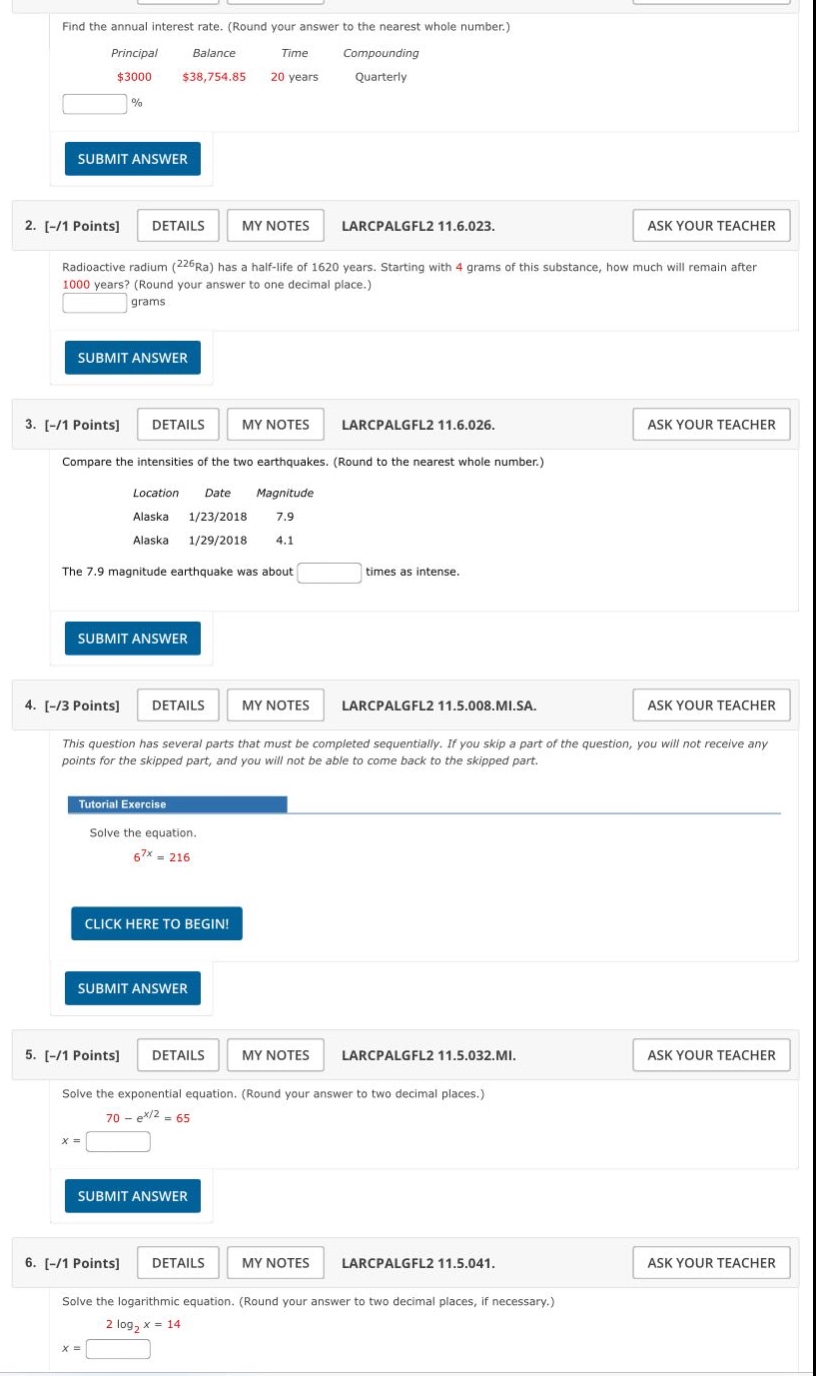
1. find the annual interest rate. (round your answer to the nearest whole number.)\nprincipal $3000 balance $38,754.85 time 20 years compounding quarterly\n\n2. -/1 points details my notes larcpalgfl2 11.6.023.\nradioactive radium ($^{226}$ra) has a half - life of 1620 years. starting with 4 grams of this substance, how much will remain after 1000 years? (round your answer to one decimal place.)\n\n3. -/1 points details my notes larcpalgfl2 11.6.026.\ncompare the intensities of the two earthquakes. (round to the nearest whole number.)\nlocation date magnitude\nalaska 1/23/2018 7.9\nalaska 1/29/2018 4.1\nthe 7.9 magnitude earthquake was about \n\n4. -/3 points details my notes larcpalgfl2 11.5.008.mi.sa.\nthis question has several parts that must be completed sequentially. if you skip a part of the question, you will not receive any points for the skipped part, and you will not be able to come back to the skipped part.\ntutorial exercise\nsolve the equation.\n$6^{7x}=216$\n\n5. -/1 points details my notes larcpalgfl2 11.5.032.mi.\nsolve the exponential equation. (round your answer to two decimal places.)\n$70 - e^{x/2}=65$\n\n6. -/1 points details my notes larcpalgfl2 11.5.041.\nsolve the logarithmic equation. (round your answer to two decimal places, if necessary.)\n$2log_2x = 14$
Answer
1.
Explanation:
Step1: Recall compound - interest formula
The compound - interest formula is $A = P(1+\frac{r}{n})^{nt}$, where $A$ is the balance, $P$ is the principal, $r$ is the annual interest rate (in decimal), $n$ is the number of times compounded per year, and $t$ is the number of years. Here, $P = 3000$, $A=38754.85$, $n = 4$ (quarterly compounding), and $t = 20$. So, $38754.85=3000(1 +\frac{r}{4})^{4\times20}$.
Step2: Isolate the exponential term
First, divide both sides by 3000: $\frac{38754.85}{3000}=(1 +\frac{r}{4})^{80}$. So, $12.918283=(1 +\frac{r}{4})^{80}$.
Step3: Take the 80th root of both sides
$12.918283^{\frac{1}{80}}=1+\frac{r}{4}$. Using a calculator, $12.918283^{\frac{1}{80}}\approx1.03$. Then $1.03 = 1+\frac{r}{4}$.
Step4: Solve for $r$
Subtract 1 from both sides: $0.03=\frac{r}{4}$. Multiply both sides by 4 to get $r = 0.12$ or $12%$.
Answer:
$12$
2.
Explanation:
Step1: Recall the half - life formula
The formula for radioactive decay is $A=A_0(\frac{1}{2})^{\frac{t}{T}}$, where $A_0$ is the initial amount, $t$ is the time elapsed, and $T$ is the half - life. Here, $A_0 = 4$, $t = 1000$, and $T = 1620$.
Step2: Substitute the values into the formula
$A = 4(\frac{1}{2})^{\frac{1000}{1620}}$.
Step3: Calculate the value
First, calculate $\frac{1000}{1620}\approx0.6173$. Then $(\frac{1}{2})^{0.6173}\approx0.657$. Multiply by 4: $A\approx4\times0.657 = 2.628\approx2.6$.
Answer:
$2.6$
3.
Explanation:
Step1: Recall the formula for earthquake intensity
The magnitude $M$ of an earthquake is related to the intensity $I$ by the formula $M=\log(\frac{I}{I_0})$, where $I_0$ is a reference intensity. If $M_1$ and $M_2$ are the magnitudes of two earthquakes, then $M_1 - M_2=\log(\frac{I_1}{I_2})$. Here, $M_1 = 7.9$ and $M_2 = 4.1$. So, $7.9−4.1=\log(\frac{I_1}{I_2})$.
Step2: Simplify the left - hand side
$3.8=\log(\frac{I_1}{I_2})$.
Step3: Convert from logarithmic to exponential form
By the definition of logarithms, if $\log(x)=y$, then $x = 10^y$. So, $\frac{I_1}{I_2}=10^{3.8}\approx6310$.
Answer:
$6310$
4.
Explanation:
Step1: Rewrite 216 as a power of 6
We know that $216 = 6^3$. So the equation $6^{7x}=216$ becomes $6^{7x}=6^3$.
Step2: Set the exponents equal
Since the bases are the same, we can set the exponents equal: $7x=3$.
Step3: Solve for $x$
Divide both sides by 7: $x=\frac{3}{7}\approx0.43$.
Answer:
$\frac{3}{7}$
5.
Explanation:
Step1: Isolate the exponential term
Starting with $70 - e^{\frac{x}{2}}=65$, subtract 70 from both sides: $-e^{\frac{x}{2}}=65 - 70=-5$. Then multiply both sides by - 1 to get $e^{\frac{x}{2}}=5$.
Step2: Take the natural logarithm of both sides
$\ln(e^{\frac{x}{2}})=\ln(5)$.
Step3: Use the property of logarithms
Since $\ln(e^a)=a$, we have $\frac{x}{2}=\ln(5)$. Multiply both sides by 2: $x = 2\ln(5)\approx2\times1.6094 = 3.22$.
Answer:
$3.22$
6.
Explanation:
Step1: Simplify the logarithmic equation
Given $2\log_2x = 14$, divide both sides by 2: $\log_2x = 7$.
Step2: Convert from logarithmic to exponential form
By the definition of logarithms, if $\log_a b=c$, then $b=a^c$. So, $x = 2^7=128$.
Answer:
$128$