find the area of the trapezoid. if the answer is not an integer, leave it in simplest radical form. the…
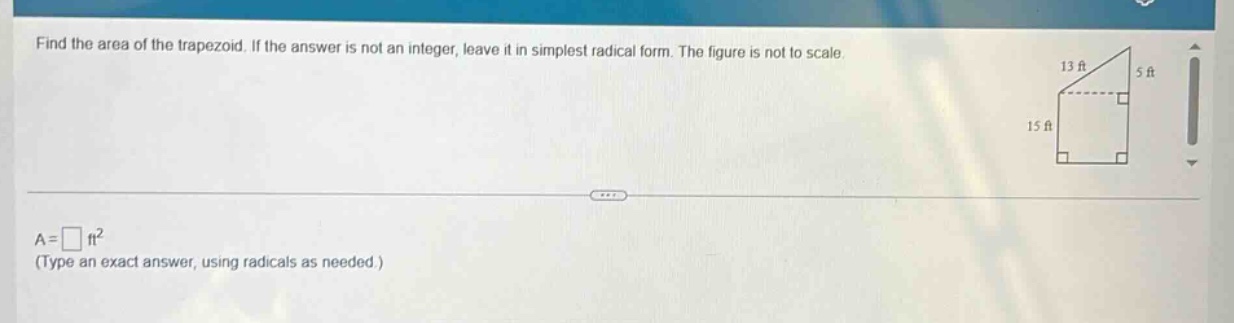
find the area of the trapezoid. if the answer is not an integer, leave it in simplest radical form. the figure is not to scale.\na = □ ft²\n(type an exact answer, using radicals as needed.)
Answer
Explanation:
Step1: Find the length of the non - parallel side base part
We first find the length of the base part of the non - parallel side of the trapezoid. Using the Pythagorean theorem in the right - triangle formed on the top of the trapezoid. The height of the right - triangle is (h = 5) ft and the hypotenuse is (c = 13) ft. Let the base of the right - triangle be (x). Then by (c^{2}=a^{2}+b^{2}), we have (x=\sqrt{13^{2}-5^{2}}=\sqrt{169 - 25}=\sqrt{144}=12) ft.
Step2: Identify the bases and height of the trapezoid
The lengths of the bases of the trapezoid are (b_1) and (b_2), and the height (h). The shorter base (b_1) (the horizontal part of the upper part) is (12) ft, the longer base (b_2=12 + 15=27) ft, and the height (h = 15+5 = 20) ft.
Step3: Use the trapezoid area formula
The area formula of a trapezoid is (A=\frac{(b_1 + b_2)h}{2}). Substitute (b_1 = 12) ft, (b_2=27) ft, and (h = 20) ft into the formula: (A=\frac{(12 + 27)\times20}{2}). First, calculate the sum of the bases: (12+27 = 39) ft. Then, (A=\frac{39\times20}{2}=390) (ft^{2}).
Answer:
(390)