find the direction of $-vec{a}-vec{b}$. express your answer in degrees. angle = ° counterclockwise from +x…
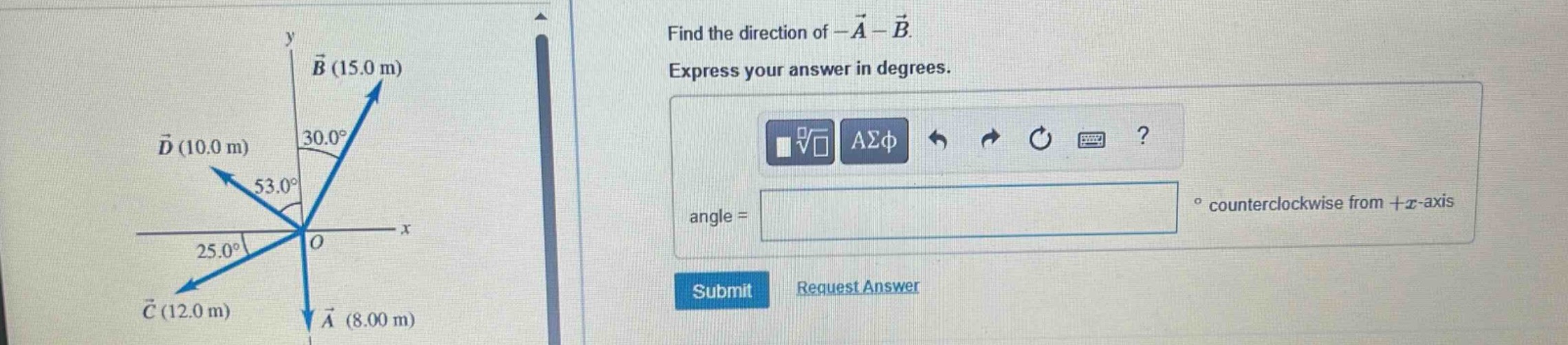
find the direction of $-vec{a}-vec{b}$. express your answer in degrees. angle = ° counterclockwise from +x - axis
Answer
Explanation:
Step1: Write vectors in component - form
For $\vec{A}=(8.00\ m)$ along the negative $y -$axis, $\vec{A}=0\hat{i}- 8\hat{j}$. For $\vec{B}=(15.0\ m)$ at an angle of $30.0^{\circ}$ with the positive $y -$axis, $B_x = 15\sin30^{\circ}=7.5\ m$ and $B_y=15\cos30^{\circ}=15\times\frac{\sqrt{3}}{2}\approx12.99\ m$, so $\vec{B}=7.5\hat{i}+12.99\hat{j}$.
Step2: Calculate $-\vec{A}-\vec{B}$
$-\vec{A}-\vec{B}=(0 - 7.5)\hat{i}+(8 - 12.99)\hat{j}=-7.5\hat{i}-4.99\hat{j}$.
Step3: Find the direction of the vector
The direction $\theta$ of a vector $\vec{R}=R_x\hat{i}+R_y\hat{j}$ is given by $\tan\theta=\frac{R_y}{R_x}$. Here, $R_x=-7.5$ and $R_y = - 4.99$, so $\tan\theta=\frac{-4.99}{-7.5}\approx0.665$. Since both components are negative, the vector lies in the third - quadrant. $\theta=\arctan(0.665)+180^{\circ}$. $\arctan(0.665)\approx33.6^{\circ}$, so $\theta\approx33.6^{\circ}+180^{\circ}=213.6^{\circ}$.
Answer:
$213.6$