find an equation for the sine graph, $f(x)$:\nwrite your answer in the form $f(x) = a \\sin(bx + c) + d$…
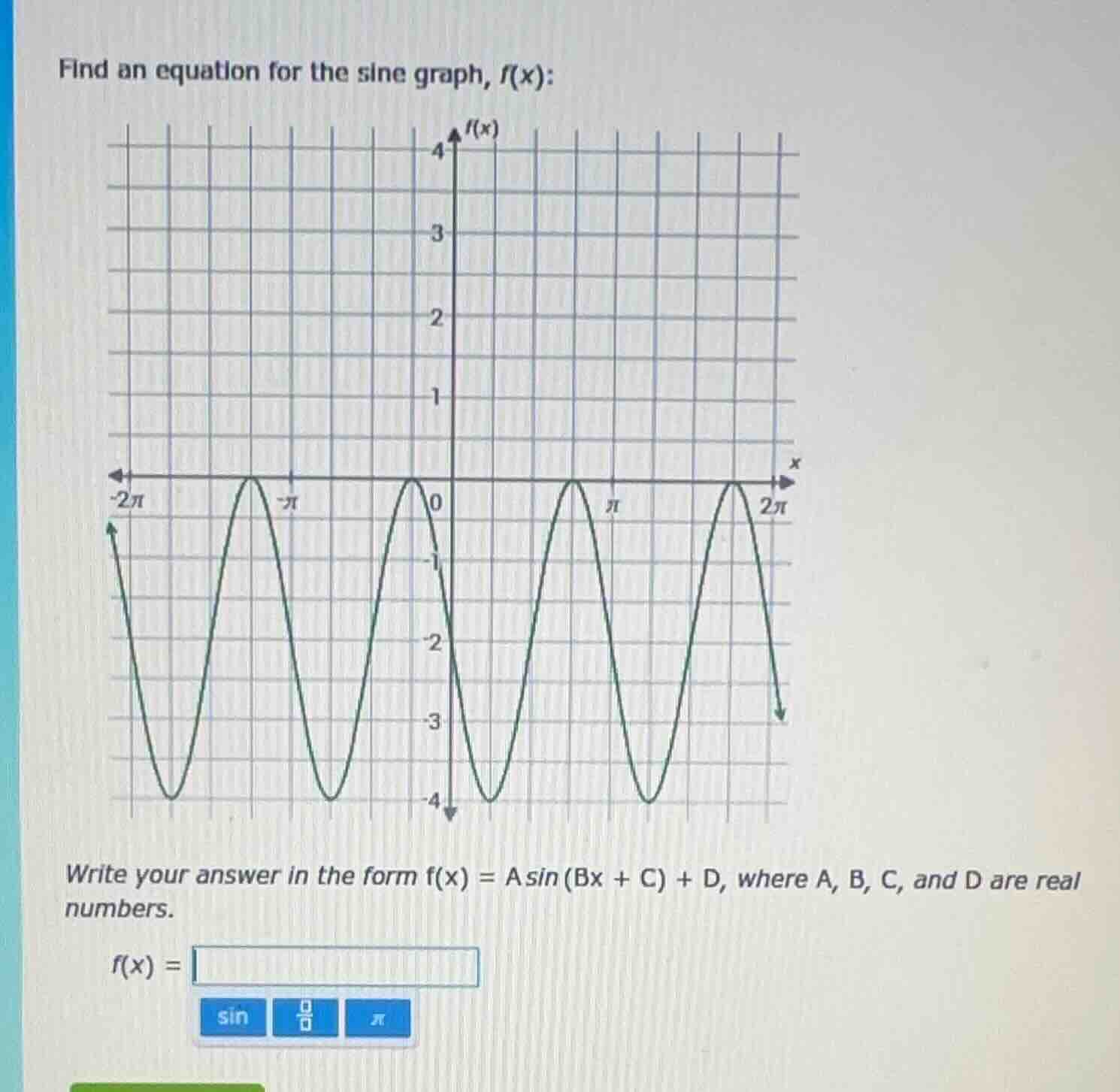
find an equation for the sine graph, $f(x)$:\nwrite your answer in the form $f(x) = a \\sin(bx + c) + d$, where $a, b, c$, and $d$ are real numbers.\n$f(x) = $
Answer
Explanation:
Step1: Identify the midline and vertical shift
The maximum value is $0$ and the minimum value is $-4$. The midline $D$ is the average. $$D = \frac{0 + (-4)}{2} = -2$$
Step2: Determine the amplitude
The amplitude $A$ is the distance from the midline to the maximum. $$A = 0 - (-2) = 2$$
Step3: Determine the period and frequency
The graph completes one cycle from $x = -\frac{\pi}{2}$ to $x = \frac{\pi}{2}$. The period $P$ is $\pi$. $$B = \frac{2\pi}{P} = \frac{2\pi}{\pi} = 2$$
Step4: Determine the phase shift
The standard sine starts at the midline moving up. Here, it starts at the midline $(0, -2)$ moving down. This indicates a reflection or a phase shift. Using a negative amplitude: $$f(x) = -2\sin(2x) - 2$$
Step5: Verify with a point
Check point $(\frac{\pi}{4}, -4)$: $f(\frac{\pi}{4}) = -2\sin(2 \cdot \frac{\pi}{4}) - 2 = -2\sin(\frac{\pi}{2}) - 2 = -2(1) - 2 = -4$. This is correct.
Answer:
f(x) = -2\sin(2x) - 2