find the length of the third side. if necessary, write in simplest radical form. answer attempt 1 out of 2
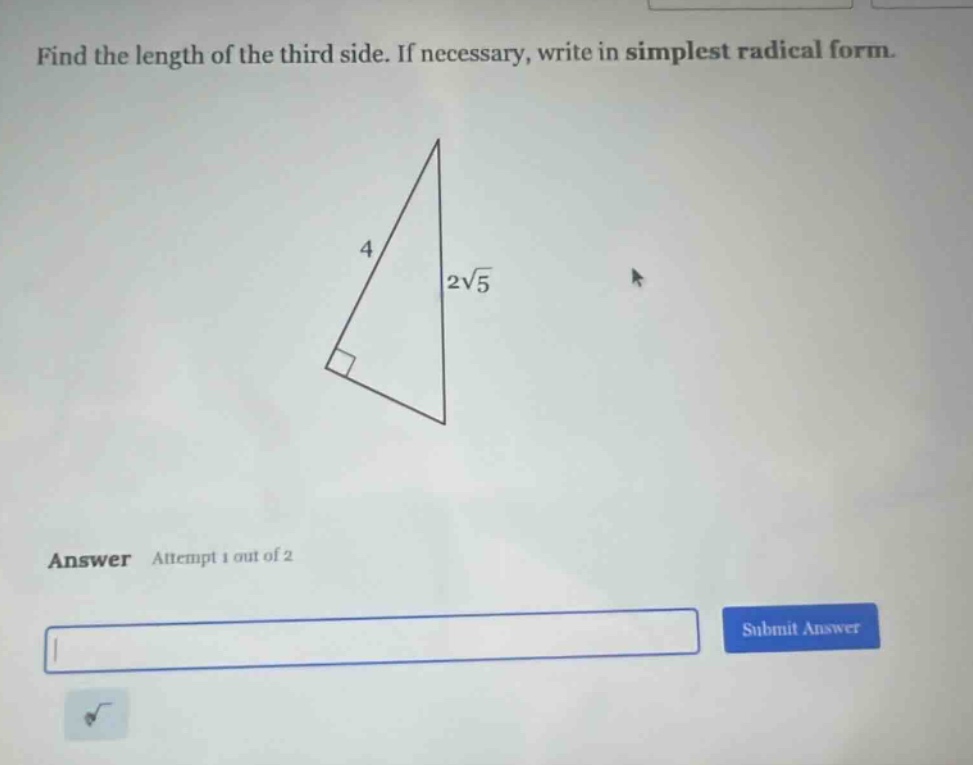
find the length of the third side. if necessary, write in simplest radical form. answer attempt 1 out of 2
Answer
Explanation:
Step1: Apply Pythagorean theorem
Let the hypotenuse be $c = 4$ and one - leg be $a = 2\sqrt{5}$. The Pythagorean theorem is $c^{2}=a^{2}+b^{2}$ (for a right - triangle), and we want to find the other leg $b$. So, $b^{2}=c^{2}-a^{2}$.
Step2: Substitute the values
Substitute $c = 4$ and $a = 2\sqrt{5}$ into the formula. $c^{2}=4^{2}=16$ and $a^{2}=(2\sqrt{5})^{2}=2^{2}\times(\sqrt{5})^{2}=4\times5 = 20$. Then $b^{2}=16 - 20=-4$. But this is wrong. Let's assume $c$ is the unknown hypotenuse, $a = 2\sqrt{5}$ and $b = 4$. Then $c^{2}=a^{2}+b^{2}$.
Step3: Calculate $c^{2}$
$a^{2}=(2\sqrt{5})^{2}=20$ and $b^{2}=4^{2}=16$. So $c^{2}=20 + 16=36$.
Step4: Find $c$
Take the square - root of $c^{2}$. $c=\sqrt{36}=6$.
Answer:
6