find the measure of the missing angles. answer attempt 1 out of 2 d = ° e = ° f = °
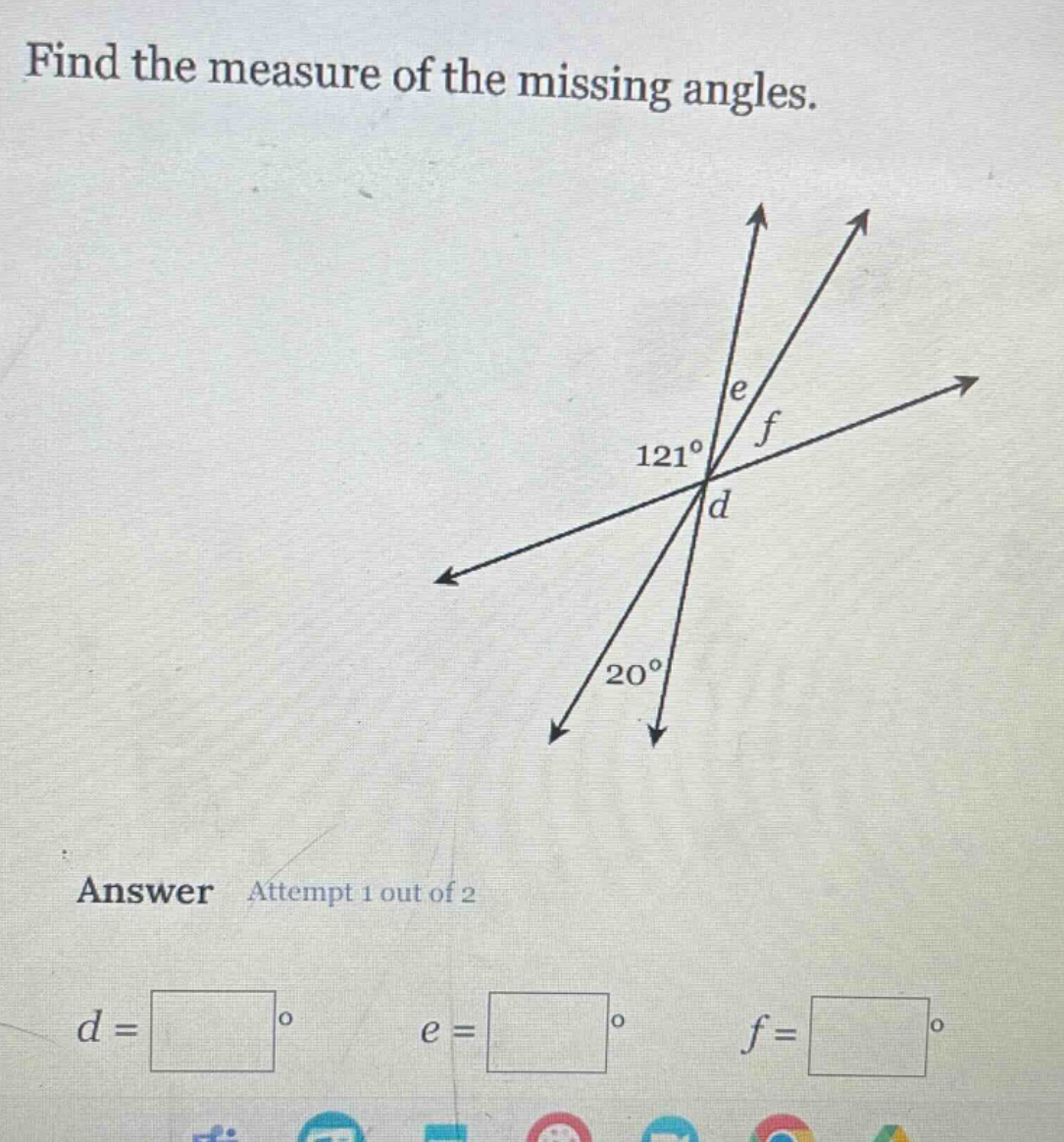
find the measure of the missing angles. answer attempt 1 out of 2 d = ° e = ° f = °
Answer
Explanation:
Step1: Use linear - pair property for angle (d)
A linear - pair of angles sums to (180^{\circ}). Since the angle adjacent to (d) is (121^{\circ}), we have (d = 180^{\circ}-121^{\circ}). [d=59^{\circ}]
Step2: Use angle - sum property for angles (d), (20^{\circ}), (e) and (f)
The sum of angles around a point is (360^{\circ}). We know (d = 59^{\circ}) and one of the angles is (20^{\circ}), and the non - labeled part of the (121^{\circ}) angle is (180 - 121=59^{\circ}). Also, (d + 20^{\circ}+e + f=180^{\circ}) (a straight - line angle). First, find the sum of the known angles on the straight - line: (d + 20^{\circ}=59^{\circ}+20^{\circ}=79^{\circ}). Then (e + f=180^{\circ}-79^{\circ}=101^{\circ}). We also know that the non - labeled part of the (121^{\circ}) angle and (e) and (f) form a straight - line. Since the non - labeled part of the (121^{\circ}) angle is (59^{\circ}), and (59^{\circ}+e + f = 180^{\circ}). We use the fact that (d) and the non - labeled part of the (121^{\circ}) angle are vertical angles. Since (d = 59^{\circ}), and considering the straight - line with the (20^{\circ}) angle, we know that (e=180^{\circ}-(121^{\circ}+20^{\circ})) [e = 39^{\circ}]
Step3: Find angle (f)
Since (e + f) and the (121^{\circ}) angle and (20^{\circ}) angle form a full - circle (sum to (360^{\circ})), or using the fact that (e + f) is on a straight - line with (d) and (20^{\circ}). We know (e + f=180^{\circ}-(d + 20^{\circ})), substituting (d = 59^{\circ}), we get (e + f = 101^{\circ}), and since (e = 39^{\circ}), then (f=101^{\circ}-39^{\circ}) [f = 62^{\circ}]
Answer:
(d = 59^{\circ}), (e = 39^{\circ}), (f = 62^{\circ})