find the measure of the missing angles.\nanswer attempt 1 out of 2\nd = \n e = \n f =
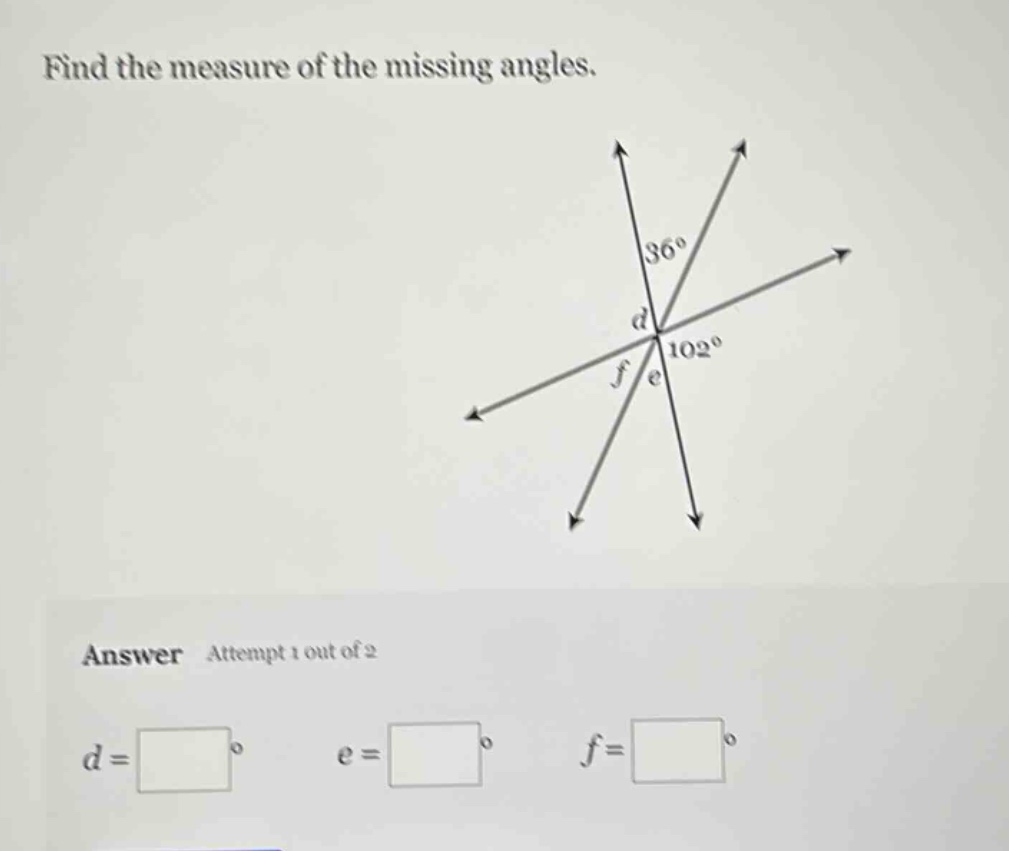
find the measure of the missing angles.\nanswer attempt 1 out of 2\nd = \n e = \n f =
Answer
Explanation:
Step1: Use angle - sum property of a circle
The sum of angles around a point is 360°.
Step2: Find angle (d)
We know that (d + 36^{\circ}+102^{\circ}+e + f=360^{\circ}). First, assume the angles are arranged such that we can find (d) using the fact that vertical - angles are equal. If we consider the non - overlapping angles, and assume the given angles are part of a complete 360 - degree set around the point. Since there is no other information about the relationship of the angles other than the sum around a point, and if we assume the angles are arranged in a simple non - overlapping way, we know that (d = 102^{\circ}) (vertical angles are equal).
Step3: Find angle (e)
We know that (36^{\circ}+d + e+102^{\circ}=360^{\circ}). Substitute (d = 102^{\circ}) into the equation: (36^{\circ}+102^{\circ}+e + 102^{\circ}=360^{\circ}). Then (e=360^{\circ}-(36^{\circ}+102^{\circ}+102^{\circ})=360^{\circ}-240^{\circ}=120^{\circ}).
Step4: Find angle (f)
Since (d) and (f) are vertical angles, (f = 36^{\circ}).
Answer:
(d = 102), (e = 120), (f = 36)