find the perimeter of the polygon.
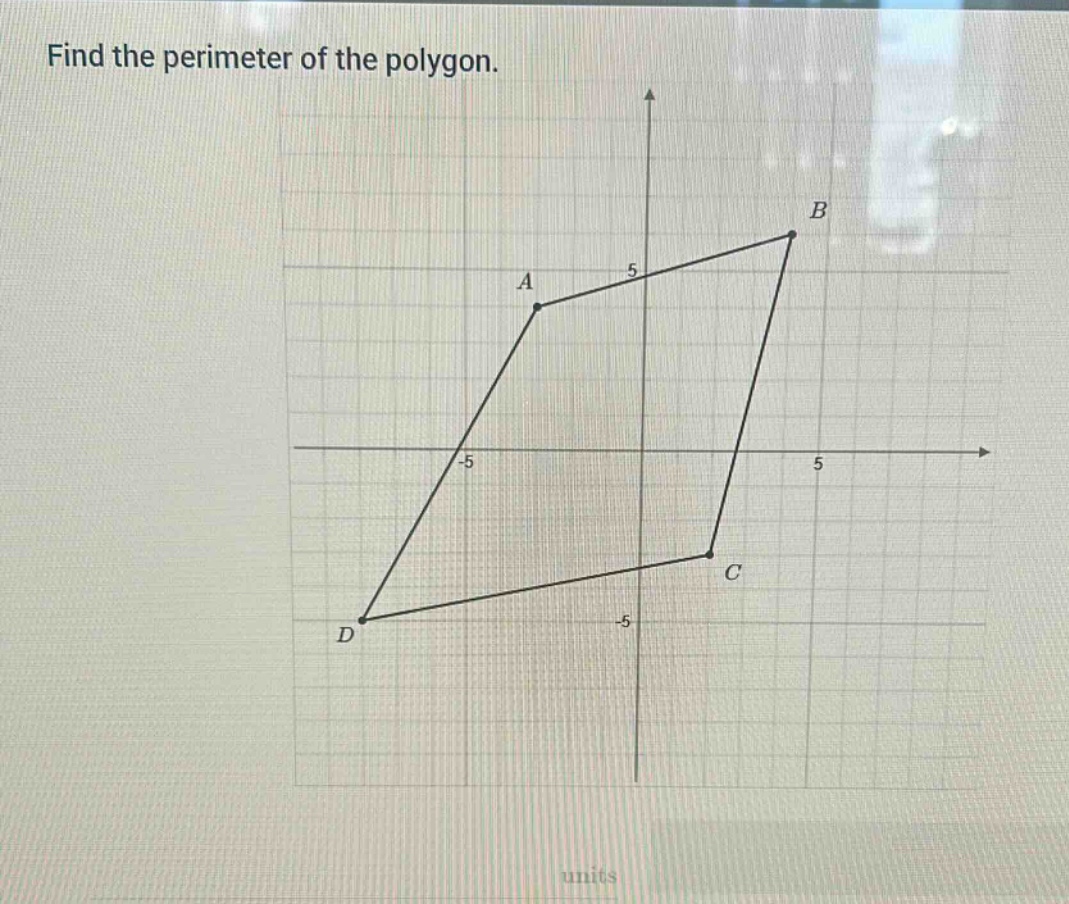
find the perimeter of the polygon.
Answer
- First, assume the coordinates of the vertices (let's assume a grid - based system where each square represents 1 unit):
- Let's say (A=( - 2,3)), (B=(4,5)), (C=(3, - 3)), (D=( - 4, - 4)).
- Use the distance formula (d = \sqrt{(x_2 - x_1)^2+(y_2 - y_1)^2}) to find the length of each side.
- For side (AB):
- (x_1=-2,y_1 = 3,x_2 = 4,y_2 = 5).
- (d_{AB}=\sqrt{(4-( - 2))^2+(5 - 3)^2}=\sqrt{(4 + 2)^2+(2)^2}=\sqrt{36 + 4}=\sqrt{40}=2\sqrt{10}\approx6.32).
- For side (BC):
- (x_1 = 4,y_1 = 5,x_2 = 3,y_2=-3).
- (d_{BC}=\sqrt{(3 - 4)^2+( - 3 - 5)^2}=\sqrt{( - 1)^2+( - 8)^2}=\sqrt{1 + 64}=\sqrt{65}\approx8.06).
- For side (CD):
- (x_1 = 3,y_1=-3,x_2=-4,y_2=-4).
- (d_{CD}=\sqrt{( - 4 - 3)^2+( - 4-( - 3))^2}=\sqrt{( - 7)^2+( - 1)^2}=\sqrt{49+1}=\sqrt{50}=5\sqrt{2}\approx7.07).
- For side (DA):
- (x_1=-4,y_1=-4,x_2=-2,y_2 = 3).
- (d_{DA}=\sqrt{( - 2-( - 4))^2+(3-( - 4))^2}=\sqrt{( - 2 + 4)^2+(3 + 4)^2}=\sqrt{4 + 49}=\sqrt{53}\approx7.28).
- Then, find the perimeter (P):
- (P=d_{AB}+d_{BC}+d_{CD}+d_{DA}).
- (P = 2\sqrt{10}+\sqrt{65}+5\sqrt{2}+\sqrt{53}).
- (P\approx6.32+8.06 + 7.07+7.28=28.73).
Explanation:
Step1: Apply distance - formula for (AB)
(d_{AB}=\sqrt{(4-( - 2))^2+(5 - 3)^2}=\sqrt{36 + 4}=\sqrt{40}=2\sqrt{10})
Step2: Apply distance - formula for (BC)
(d_{BC}=\sqrt{(3 - 4)^2+( - 3 - 5)^2}=\sqrt{1 + 64}=\sqrt{65})
Step3: Apply distance - formula for (CD)
(d_{CD}=\sqrt{( - 4 - 3)^2+( - 4-( - 3))^2}=\sqrt{49 + 1}=\sqrt{50}=5\sqrt{2})
Step4: Apply distance - formula for (DA)
(d_{DA}=\sqrt{( - 2-( - 4))^2+(3-( - 4))^2}=\sqrt{4 + 49}=\sqrt{53})
Step5: Calculate the perimeter
(P = 2\sqrt{10}+\sqrt{65}+5\sqrt{2}+\sqrt{53}\approx28.73)
Answer:
(2\sqrt{10}+\sqrt{65}+5\sqrt{2}+\sqrt{53}\approx28.73)