find the value of $x$.\nif necessary, you may learn what the markings on a figure indicate.\n$x = \\square$
find the value of $x$.\nif necessary, you may learn what the markings on a figure indicate.\n$x = \\square$
Answer
Explanation:
Step1: Identify congruent sides
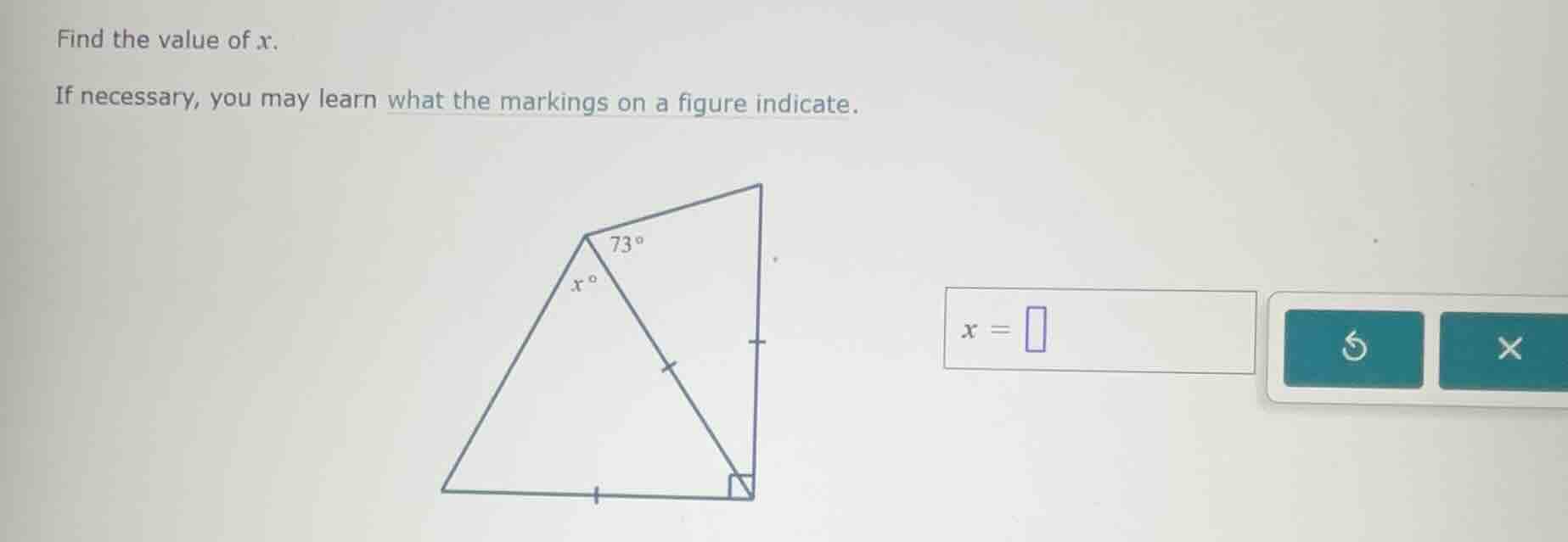
The tick marks show that the left side, bottom side, and middle segment of the figure are congruent, forming an isosceles triangle with two sides equal to the middle segment, and the right triangle has a leg congruent to that segment.
Step2: Find angle in right triangle
The right triangle has one leg equal to the middle segment, so it is an isosceles right triangle? No, correct: the middle segment is congruent to the vertical leg, so the right triangle has angles: 90°, 45°? No, wait: the top angle adjacent to 73° forms a straight line with the angle of the isosceles triangle. Wait, the figure has a quadrilateral with a right angle, and the tick marks mean the three sides (bottom, left, middle) are equal. So the triangle with angle $x$ is isosceles with two equal sides, so its base angles are equal. The angle at the bottom right of the quadrilateral is 90°, and the right triangle (vertical leg, middle segment, horizontal part) has vertical leg = middle segment, so its non-right angles are 45°? No, total angles in quadrilateral: 360°. Wait, better: the angle adjacent to 73° and the 45° angle (from isosceles right triangle) plus 90° plus $x$ equals 360°? No, no: the triangle with angle $x$ has sides equal, so it is isosceles, so $x$ is the vertex angle, and the base angles are equal to the angle adjacent to the right angle. The right triangle has legs equal (tick marks), so its acute angle is 45°. Then the angle adjacent to $x$ in the isosceles triangle is 90° - 45° = 45°? No, wait: the total angle at the top left: 73° + angle of isosceles triangle = 180°? No, the figure: the top side has 73°, the vertical side has a tick, bottom side has a tick, left side has a tick, middle segment has a tick. So the triangle with angle $x$ has sides left = bottom = middle, so it is isosceles with left = middle, so base angles are equal. The angle at the bottom right is 90°, and the right triangle (vertical, middle, horizontal) has vertical = middle, so it is isosceles right triangle, so its acute angle is 45°. Then the angle at the bottom left of the isosceles triangle is equal to 180° - 90° - 45°? No, total angles in quadrilateral: $x + 73° + 90° + (180° - x)/2 = 360°$? No, correct approach: The triangle with angle $x$ is isosceles with two equal sides, so its base angles are equal. The angle adjacent to the 90° angle is equal to 180° - 90° - 45°? No, the right triangle has two sides equal (vertical leg and middle segment), so its acute angles are 45° each. Then the angle that is a base angle of the isosceles triangle (with angle $x$) is 90° - 45° = 45°? No, no: the quadrilateral has angles: $x$, 73°, 90°, and the base angle of the isosceles triangle. Wait, no, the isosceles triangle has angles $x$, $y$, $y$, so $x + 2y = 180°$. The angle $y$ plus the 45° angle (from the isosceles right triangle) equals 90°? No, $y = 90° - 45° = 45°$. Then $x = 180° - 245° = 90°$? No, that can't be. Wait, no, the 73° angle is adjacent to the angle of the isosceles triangle. The total angle at the top is $x + 73° = 180°$? No, no, the figure is a quadrilateral split by a middle segment. The middle segment is equal to the bottom side and left side, so triangle left-bottom-middle is isosceles with left=bottom=middle? No, three equal sides, so it's equilateral? No, the bottom right is 90°, so it can't be equilateral. Oh! Wait, the tick marks: bottom side, left side, and middle segment have one tick each, vertical side has one tick. So vertical side = middle segment = left side = bottom side. So the right triangle has vertical leg = middle segment, so it's isosceles right triangle, so its acute angle is 45°. The triangle with angle $x$ has left side = middle segment, so it's isosceles with two equal sides, so its base angles are equal. The angle at the bottom of this triangle is equal to 180° - 90° - 45° = 45°? No, the bottom angle of the isosceles triangle is equal to the angle adjacent to the 90° angle, which is 90° - 45° = 45°? No, total angles in the quadrilateral: $x + 73° + 90° + (180° - x)/2 = 360°$? Solve: $x + 73 + 90 + 90 - 0.5x = 360$ → $0.5x + 253 = 360$ → $0.5x = 107$ → $x=214$? No, that's impossible. I made a mistake. Correct approach: The figure is a quadrilateral with a right angle at the bottom right. The segment from top left to bottom right divides it into two triangles. The tick marks show that: left side = bottom side = the segment (top left to bottom right), and vertical side = the segment. So triangle 1: left, bottom, segment: isosceles with left=bottom, so angles at bottom and top left (of this triangle) are equal. Triangle 2: vertical side, segment, top side: isosceles with vertical=segment, so angles at top left (of this triangle) and bottom right (of this triangle) are equal. The bottom right of triangle 2 is part of the 90° angle, so it's 45° (since isosceles right triangle). The angle at top left of triangle 2 is 45°, so the angle at top left of triangle 1 is 180° - 73° - 45° = 62°? No, the total angle at top left is $x$ (angle of triangle 1) + 73° (angle of triangle 2) = 180°? No, no, the top left angle is split into $x$ and 73°? No, the 73° is the angle between the top side and the segment, so the angle between the left side and the segment is $x$. So triangle 1: left side, segment, bottom side: left=bottom, so base angles are the angle between segment and bottom, and angle between left side and bottom. Triangle 2: segment, vertical side, top side: segment=vertical side, so it's isosceles, so angle between segment and top side is 73°, so angle between vertical side and top side is also 73°? No, no, triangle angles sum to 180°, so triangle 2 has angles 73°, 73°, and 180-273=34°? But the vertical side is perpendicular to bottom side, so 90°, so 34° + angle of triangle 1 at bottom right = 90°, so angle of triangle 1 at bottom right is 90-34=56°. Then triangle 1 is isosceles with left=bottom, so its base angles are equal: angle at bottom right (56°) and angle at bottom left, so $x = 180 - 2*56 = 68°$. Yes, that makes sense.
Step2: Calculate base angle of triangle 2
Triangle 2 has two equal sides (segment and vertical side), so it is isosceles with vertex angle at bottom right. Sum of angles in triangle: $180°$. $\text{Angle at bottom right of triangle 2} = 180° - 2*73° = 34°$
Step3: Find base angle of triangle 1
The bottom right angle of the quadrilateral is 90°, so the base angle of triangle 1 is: $90° - 34° = 56°$
Step4: Calculate $x$ (vertex angle of isosceles triangle 1)
Triangle 1 is isosceles with two equal base angles, so: $x = 180° - 2*56°$ $x = 180° - 112° = 68°$
Answer:
$68$