find the value of x.\nwrite your answer as a whole number or a decimal.\nx = \nsubmit
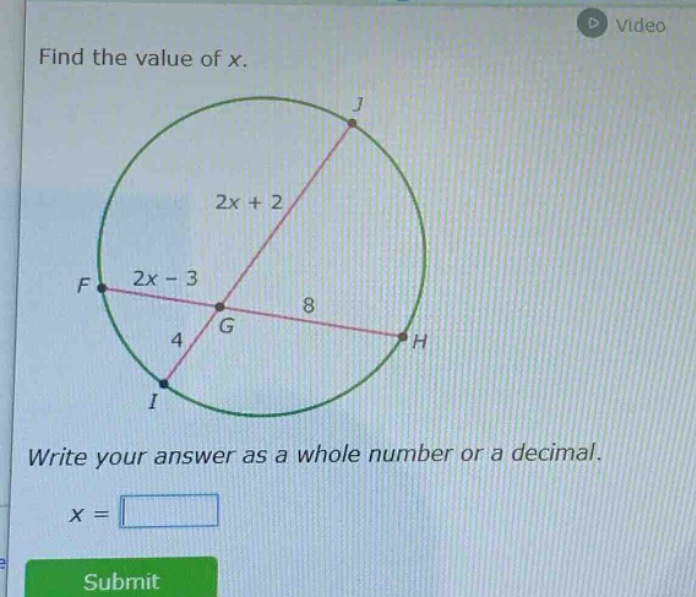
find the value of x.\nwrite your answer as a whole number or a decimal.\nx = \nsubmit
Answer
Explanation:
Step1: Apply the intersecting - chords theorem
If two chords (FH) and (JI) intersect at a point (G) inside a circle, then (FG\times GH=IG\times GJ). Here, (FG = 4), (GH = 8), (IG=2x - 3), and (GJ = 2x + 2). So, (4\times8=(2x - 3)(2x + 2)).
Step2: Expand the right - hand side
Using the FOIL method ((a + b)(c + d)=ac+ad+bc+bd), we have ((2x - 3)(2x + 2)=4x^{2}+4x-6x - 6=4x^{2}-2x - 6). And (4\times8 = 32), so the equation becomes (4x^{2}-2x-6 = 32).
Step3: Rearrange the equation to standard quadratic form
Subtract 32 from both sides: (4x^{2}-2x-6 - 32=0), which simplifies to (4x^{2}-2x - 38 = 0). Divide through by 2 to get (2x^{2}-x - 19 = 0).
Step4: Use the quadratic formula (x=\frac{-b\pm\sqrt{b^{2}-4ac}}{2a})
For the quadratic equation (2x^{2}-x - 19 = 0), (a = 2), (b=-1), and (c=-19). First, calculate the discriminant (\Delta=b^{2}-4ac=(-1)^{2}-4\times2\times(-19)=1 + 152 = 153). Then (x=\frac{1\pm\sqrt{153}}{4}=\frac{1\pm3\sqrt{17}}{4}). We take the positive root since (x) represents a length - related value in a geometric context. (x=\frac{1 + 3\sqrt{17}}{4}\approx\frac{1+3\times4.123}{4}=\frac{1 + 12.369}{4}=\frac{13.369}{4}=3.34225\approx3.3)
Answer:
(3.3)