fiona solved the equation shown. (\frac{1}{2}-\frac{1}{3}(6x - 3)=-\frac{13}{2}) fionas solution\n|steps|resu…
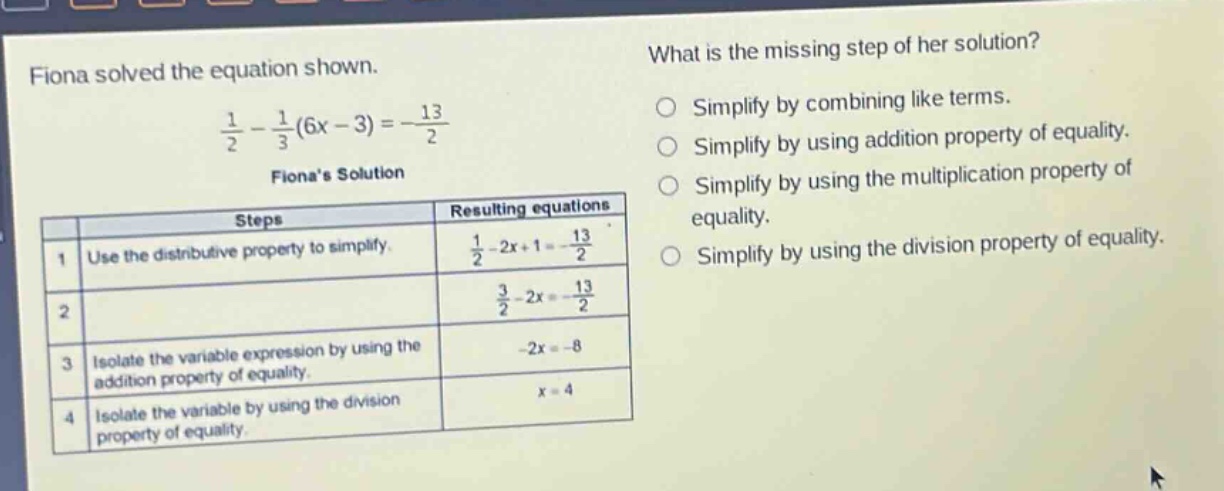
fiona solved the equation shown. (\frac{1}{2}-\frac{1}{3}(6x - 3)=-\frac{13}{2}) fionas solution\n|steps|resulting equations|\n|----|----|\n|1|use the distributive property to simplify. (\frac{1}{2}-2x + 1=-\frac{13}{2})|\n|2|(\frac{3}{2}-2x=-\frac{13}{2})|\n|3|isolate the variable expression by using the addition property of equality. (-2x=-8)|\n|4|isolate the variable by using the division property of equality. (x = 4)|\nwhat is the missing step of her solution?\nsimplify by combining like terms.\nsimplify by using addition property of equality.\nsimplify by using the multiplication property of equality.\nsimplify by using the division property of equality.
Answer
Brief Explanations:
The problem asks to identify the missing step (Step 2) in Fiona's process of solving the linear equation. Step 1 applies the distributive property to the equation $\frac{1}{2} - \frac{1}{3}(6x - 3) = -\frac{13}{2}$ (assuming the final steps are correct, the RHS should be $-\frac{13}{2}$), resulting in $\frac{1}{2} - 2x + 1 = -\frac{13}{2}$. The resulting equation after Step 2 is shown as $\frac{3}{2} - 2x = -\frac{13}{2}$ (again, correcting the RHS based on subsequent steps). To get from the equation after Step 1 to the equation after Step 2, the constant terms on the left side, $\frac{1}{2}$ and $1$, are combined: $\frac{1}{2} + 1 = \frac{1}{2} + \frac{2}{2} = \frac{3}{2}$. This operation is called combining like terms. Step 3 uses the addition property of equality (subtracting $\frac{3}{2}$ from both sides) to get $-2x = -8$. Step 4 uses the division property of equality (dividing both sides by -2) to get $x = 4$. Therefore, the missing Step 2 is simplifying by combining like terms.
Answer:
Simplify by combining like terms.