the first figure of the sierpinski triangle has one shaded triangle. the second figure of the sierpinski…
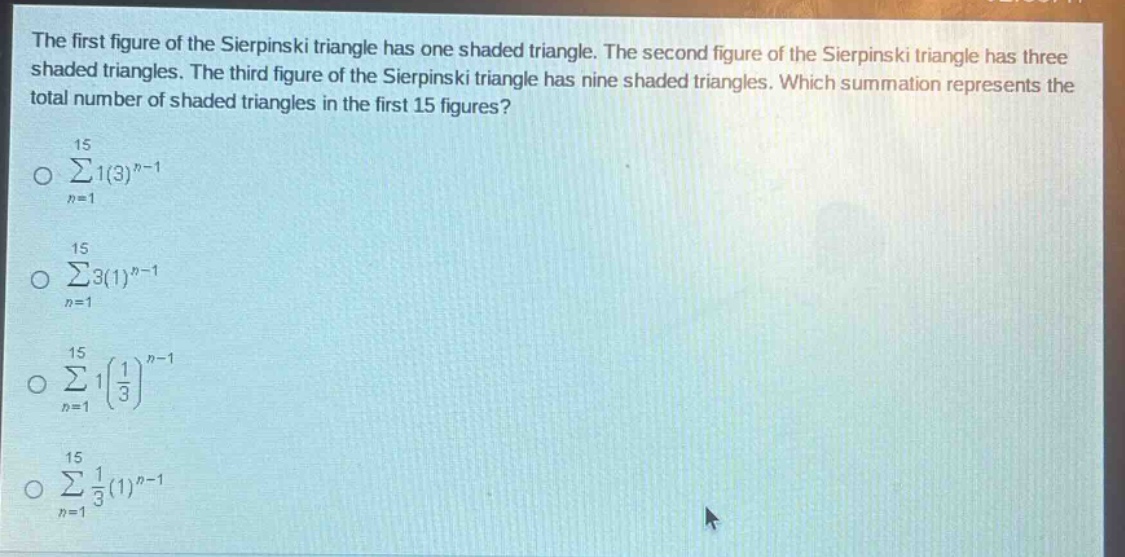
the first figure of the sierpinski triangle has one shaded triangle. the second figure of the sierpinski triangle has three shaded triangles. the third figure of the sierpinski triangle has nine shaded triangles. which summation represents the total number of shaded triangles in the first 15 figures?\n sum_{n = 1}^{15}1(3)^{n - 1}\n sum_{n = 1}^{15}3(1)^{n - 1}\n sum_{n = 1}^{15}1left(\frac{1}{3}\right)^{n - 1}\n sum_{n = 1}^{15}\frac{1}{3}(1)^{n - 1}
Answer
Answer:
A. $\sum_{n = 1}^{15}1(3)^{n - 1}$
Explanation:
Step1: Identify the sequence type
The number of shaded triangles forms a geometric - sequence. The first term $a_1=1$, the second term $a_2 = 3$, and the third term $a_3=9$.
Step2: Find the common ratio
The common ratio $r=\frac{a_{n + 1}}{a_n}$. For example, $\frac{a_2}{a_1}=\frac{3}{1}=3$, $\frac{a_3}{a_2}=\frac{9}{3}=3$.
Step3: Recall the sum formula for a geometric series
The sum of the first $n$ terms of a geometric series is $S_n=\sum_{k = 1}^{n}a_1r^{k - 1}$, where $a_1$ is the first - term and $r$ is the common ratio.
Step4: Determine the values for this problem
Here, $a_1 = 1$, $r = 3$, and $n = 15$. So the sum of the number of shaded triangles in the first 15 figures is $\sum_{n = 1}^{15}1(3)^{n - 1}$.