the first step for deriving the quadratic formula from the quadratic equation, 0 = ax² + bx + c, is shown…
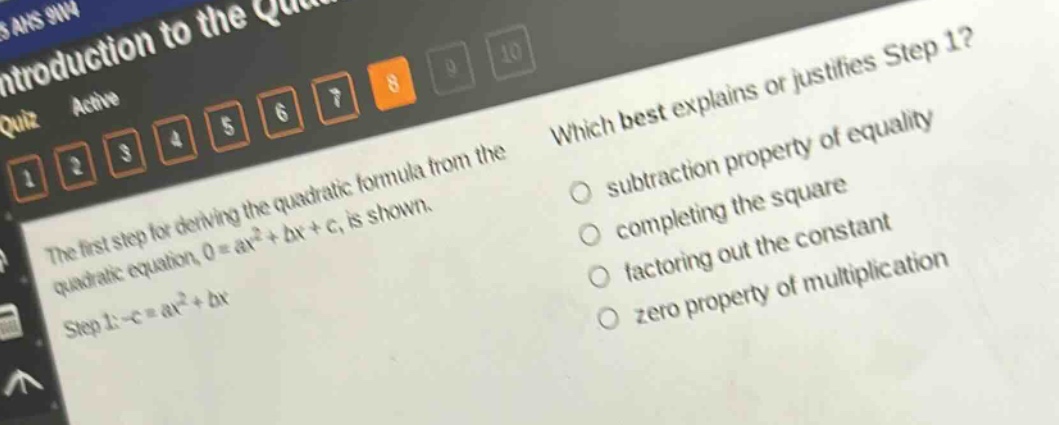
the first step for deriving the quadratic formula from the quadratic equation, 0 = ax² + bx + c, is shown. step 1: -c = ax² + bx. which best explains or justifies step 1? subtraction property of equality completing the square factoring out the constant zero property of multiplication
Answer
Explanation:
Step1: Analyze the equation transformation
Starting with $0 = ax^{2}+bx + c$, to get $-c=ax^{2}+bx$, we subtract $c$ from both sides of the equation.
Step2: Recall equality - property
The property that allows us to subtract the same value from both sides of an equation is the subtraction property of equality.
Answer:
subtraction property of equality