the first step for deriving the quadratic formula from the quadratic equation, 0 = ax² + bx + c, is shown…
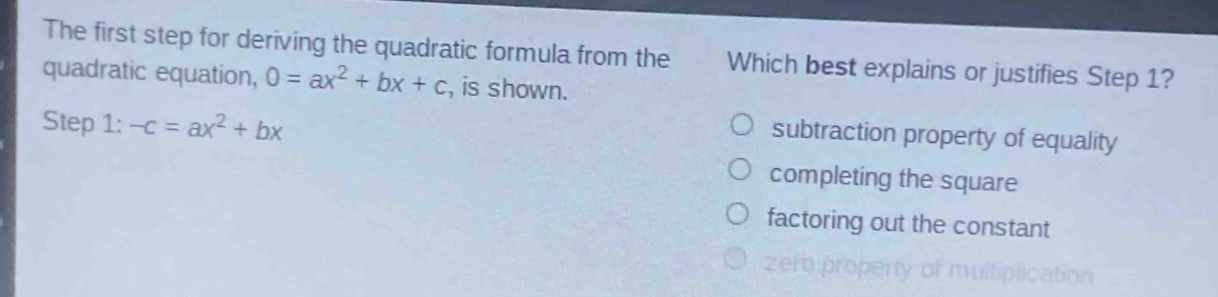
the first step for deriving the quadratic formula from the quadratic equation, 0 = ax² + bx + c, is shown. step 1: -c = ax² + bx. which best explains or justifies step 1? subtraction property of equality; completing the square; factoring out the constant; zero property of multiplication
Answer
Brief Explanations:
Starting with the quadratic equation (0 = ax^{2}+bx + c), to get (-c=ax^{2}+bx), we subtract (c) from both sides of the equation. The subtraction property of equality states that if we subtract the same number from both sides of an equation, the equality still holds.
Answer:
subtraction property of equality