the first two steps in the derivation of the quadratic formula by completing the square are shown below…
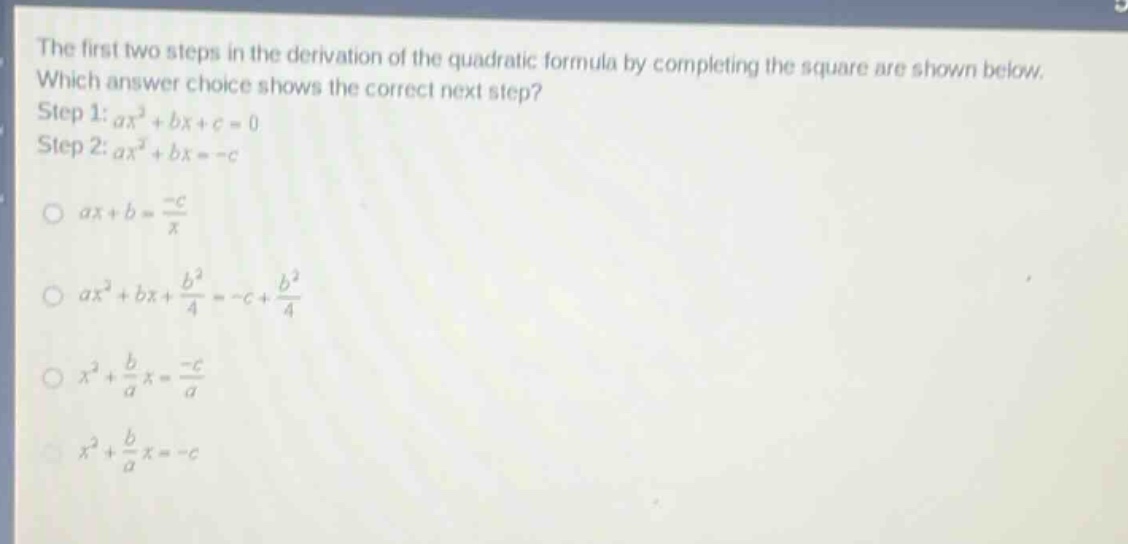
the first two steps in the derivation of the quadratic formula by completing the square are shown below. which answer choice shows the correct next step? step 1: $ax^{2}+bx + c = 0$ step 2: $ax^{2}+bx=-c$ $ax + b=\frac{-c}{x}$ $ax^{2}+bx+\frac{b^{2}}{4}=-c+\frac{b^{2}}{4}$ $x^{2}+\frac{b}{a}x=\frac{-c}{a}$ $x^{2}+\frac{b}{a}x=-c$
Answer
Explanation:
Step1: Recall completing - the - square method
To complete the square for the quadratic equation $ax^{2}+bx + c=0$, after getting $ax^{2}+bx=-c$ (Step 2), we first divide the entire equation by $a$ (assuming $a\neq0$) to make the coefficient of $x^{2}$ equal to 1. $ax^{2}+bx=-c$ implies $\frac{ax^{2}}{a}+\frac{bx}{a}=-\frac{c}{a}$, which simplifies to $x^{2}+\frac{b}{a}x =-\frac{c}{a}$.
Step2: Analyze other options
- Option $ax + b=\frac{-c}{x}$: This is obtained by dividing the left - hand side of $ax^{2}+bx=-c$ by $x$ which is an incorrect operation in the context of completing the square.
- Option $ax^{2}+bx+\frac{b^{2}}{4}=-c+\frac{b^{2}}{4}$: The correct term to add on both sides when completing the square for $x^{2}+bx$ is $\left(\frac{b}{2}\right)^{2}=\frac{b^{2}}{4}$, but we first need to make the coefficient of $x^{2}$ equal to 1. So this step is premature.
- Option $x^{2}+\frac{b}{a}x=-c$: This is incorrect because when dividing $ax^{2}+bx=-c$ by $a$, the right - hand side should be $-\frac{c}{a}$, not $-c$.
Answer:
$x^{2}+\frac{b}{a}x =-\frac{c}{a}$