the first two steps in the derivation of the quadratic formula by completing the square are shown below…
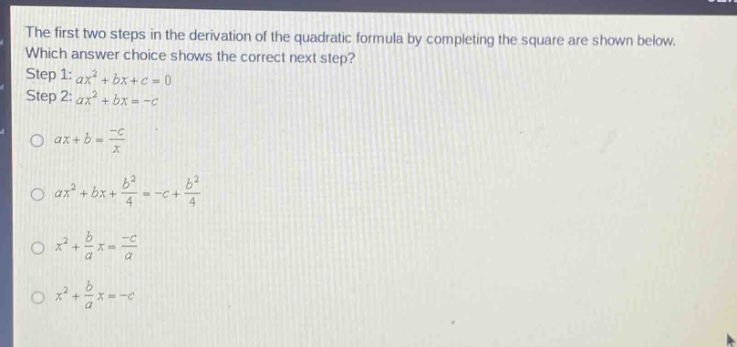
the first two steps in the derivation of the quadratic formula by completing the square are shown below. which answer choice shows the correct next step? step 1: $ax^{2}+bx + c = 0$ step 2: $ax^{2}+bx=-c$ $ax + b=\frac{-c}{x}$ $ax^{2}+bx+\frac{b^{2}}{4}=-c+\frac{b^{2}}{4}$ $x^{2}+\frac{b}{a}x=\frac{-c}{a}$ $x^{2}+\frac{b}{a}x=-c$
Answer
Explanation:
Step1: Recall completing - the - square rule
When we have an expression of the form (ax^{2}+bx) and want to complete the square, for the quadratic (ax^{2}+bx + c=0) (after getting (ax^{2}+bx=-c)), we take half of the coefficient of (x), square it and add it to both sides. The coefficient of (x) in (ax^{2}+bx) is (b). For the left - hand side to be a perfect square trinomial of the form ((mx + n)^{2}), when dealing with (ax^{2}+bx), we add (\left(\frac{b}{2a}\right)^{2}) to both sides. In the case of (ax^{2}+bx=-c), if we consider the left - hand side (ax^{2}+bx), to complete the square, we add (\frac{b^{2}}{4a}) to both sides. But if we factor out (a) from (ax^{2}+bx) first ((a\left(x^{2}+\frac{b}{a}x\right))), we can also work on (x^{2}+\frac{b}{a}x). The value to add to (x^{2}+\frac{b}{a}x) to make it a perfect square trinomial is (\left(\frac{b}{2a}\right)^{2}=\frac{b^{2}}{4a^{2}}). Another way is to directly add (\frac{b^{2}}{4a}) to both sides of (ax^{2}+bx=-c). Starting from (ax^{2}+bx=-c), we add (\frac{b^{2}}{4a}) to both sides: (ax^{2}+bx+\frac{b^{2}}{4a}=-c + \frac{b^{2}}{4a}). If we rewrite the left - hand side as a perfect square trinomial, we know that for (ax^{2}+bx), we can also add (\frac{b^{2}}{4}) to both sides when we consider the process in terms of the general steps of completing the square for the quadratic equation. The correct next step for completing the square for (ax^{2}+bx=-c) is to add (\frac{b^{2}}{4a}) to both sides. If we rewrite the left - hand side in terms of a perfect square and keep the equation balanced, we get (ax^{2}+bx+\frac{b^{2}}{4}=-c+\frac{b^{2}}{4}) (by multiplying through by (a) in a sense to simplify the form for the next steps of deriving the quadratic formula).
Step2: Analyze the options
The first option (ax + b=-\frac{c}{x}) is incorrect as it is an incorrect manipulation of the given equation. The third option (x^{2}+\frac{b}{a}x=-\frac{c}{a}) is a step that comes later in the process after dividing the original equation (ax^{2}+bx + c = 0) by (a) first. The fourth option (x^{2}+\frac{b}{a}x=-c) is also incorrect. The second option (ax^{2}+bx+\frac{b^{2}}{4}=-c+\frac{b^{2}}{4}) is the correct next step in the process of completing the square for the quadratic equation (ax^{2}+bx + c=0) after getting (ax^{2}+bx=-c).
Answer:
(ax^{2}+bx+\frac{b^{2}}{4}=-c+\frac{b^{2}}{4})