the first two steps in determining the solution set of the system of equations, y = x² - 2x - 3 and y = -x +…
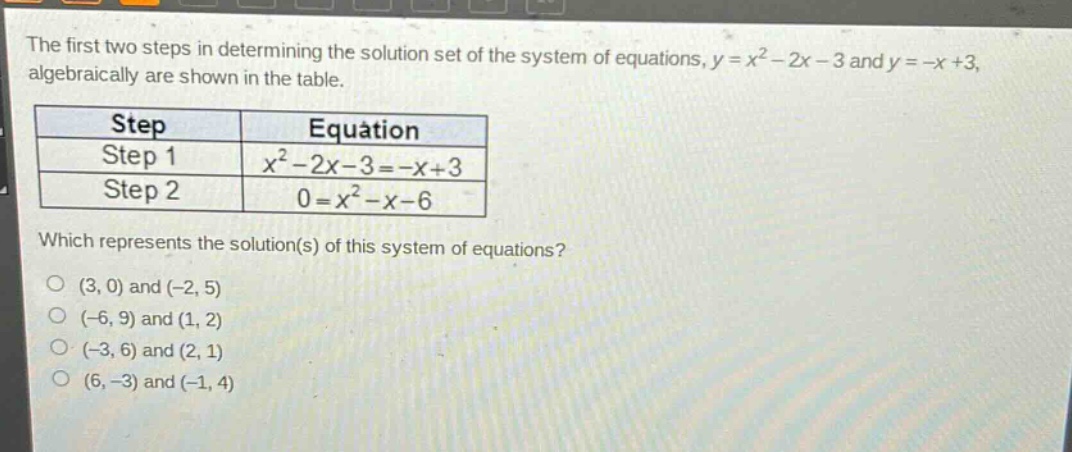
the first two steps in determining the solution set of the system of equations, y = x² - 2x - 3 and y = -x + 3, algebraically are shown in the table.\n| step | equation |\n| ---- | ---- |\n| step 1 | x² - 2x - 3 = -x + 3 |\n| step 2 | 0 = x² - x - 6 |\nwhich represents the solution(s) of this system of equations?\n(3, 0) and (-2, 5)\n(-6, 9) and (1, 2)\n(-3, 6) and (2, 1)\n(6, -3) and (-1, 4)
Answer
Explanation:
Step1: Factor the quadratic equation
Given $x^{2}-x - 6=0$, we factor it as $(x - 3)(x+2)=0$.
Step2: Solve for x
Using the zero - product property, if $(x - 3)(x + 2)=0$, then $x-3=0$ or $x + 2=0$. So $x=3$ or $x=-2$.
Step3: Find the corresponding y - values
When $x = 3$, substitute into $y=-x + 3$, we get $y=-3 + 3=0$. When $x=-2$, substitute into $y=-x + 3$, we get $y=-(-2)+3=2 + 3=5$.
Answer:
(3, 0) and (-2, 5)