a flyer is spread by people at a large conference. within one hour, the first person gives a stack of flyers…
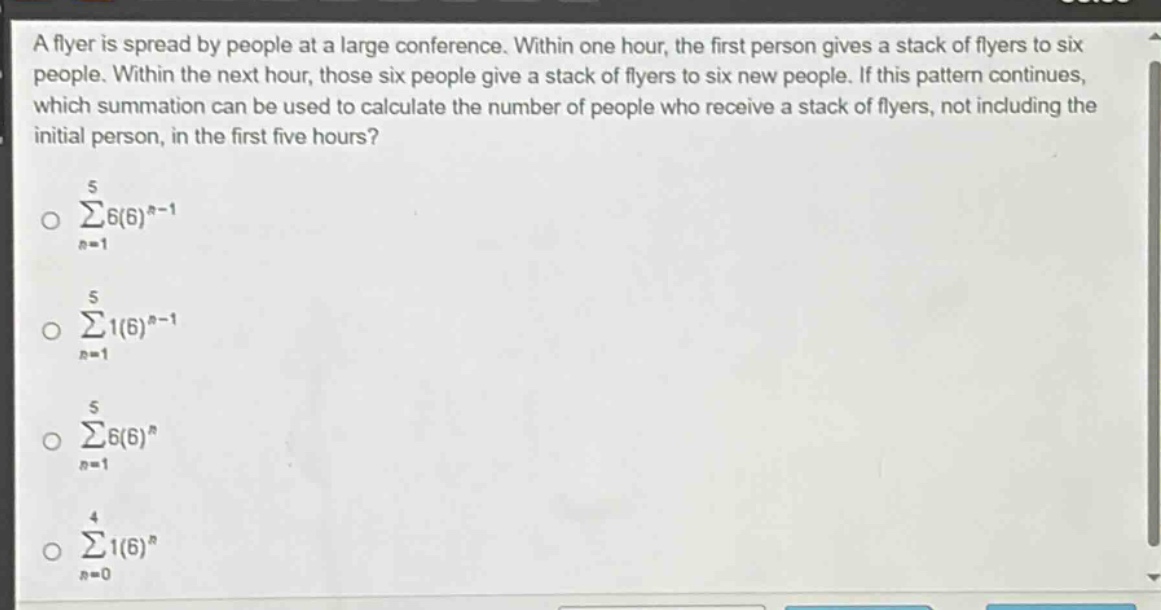
a flyer is spread by people at a large conference. within one hour, the first person gives a stack of flyers to six people. within the next hour, those six people give a stack of flyers to six new people. if this pattern continues, which summation can be used to calculate the number of people who receive a stack of flyers, not including the initial person, in the first five hours?\n sum_{n = 1}^{5}6(6)^{n - 1}\n sum_{n = 1}^{5}1(6)^{n - 1}\n sum_{n = 1}^{5}6(6)^{n}\n sum_{n = 0}^{4}1(6)^{n}
Answer
Explanation:
Step1: Identify the geometric - sequence pattern
The number of people receiving flyers forms a geometric sequence. In the first hour, 6 people receive flyers (first - term $a_1 = 6$), in the second hour, $6\times6=6^{2}$ people receive flyers, in the third hour, $6\times6^{2}=6^{3}$ people receive flyers, and so on. The general formula for the $n$th term of a geometric sequence is $a_n=a_1r^{n - 1}$, where $a_1$ is the first - term and $r$ is the common ratio. Here, $a_1 = 6$ and $r = 6$.
Step2: Determine the sum of the geometric sequence
We want to find the sum of the number of people who receive flyers in the first 5 hours (not including the initial person). The sum of the first $n$ terms of a geometric sequence is given by $S_n=\sum_{k = 1}^{n}a_1r^{k - 1}$. For our problem, $a_1 = 6$, $r = 6$, and $n = 5$. So the sum is $\sum_{n=1}^{5}6\times6^{n - 1}=\sum_{n = 1}^{5}6^{n}$.
Answer:
A. $\sum_{n = 1}^{5}6(6)^{n - 1}$