which of the following is an arithmetic sequence?\n-20, -25, -30, -35, -45, ...\n-15.6, -12.9, -10.2, -7.5…
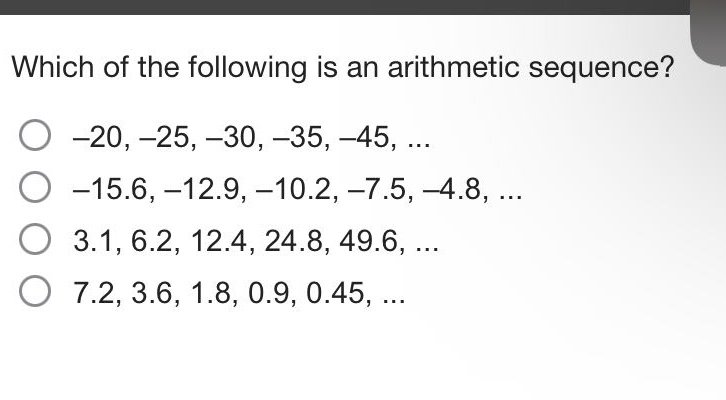
which of the following is an arithmetic sequence?\n-20, -25, -30, -35, -45, ...\n-15.6, -12.9, -10.2, -7.5, -4.8, ...\n3.1, 6.2, 12.4, 24.8, 49.6, ...\n7.2, 3.6, 1.8, 0.9, 0.45, ...
Answer
Explanation:
Step1: Recall arithmetic - sequence property
An arithmetic sequence has a common difference (d=a_{n + 1}-a_{n}) for all (n).
Step2: Check the first sequence
For the sequence (-20,-25,-30,-35,-45,\cdots), (a_2 - a_1=-25-(-20)=-5), (a_3 - a_2=-30 - (-25)=-5), (a_4 - a_3=-35-(-30)=-5), but (a_5 - a_4=-45-(-35)=-10\neq - 5), so it is not an arithmetic sequence.
Step3: Check the second sequence
For the sequence (-15.6,-12.9,-10.2,-7.5,-4.8,\cdots), (a_2 - a_1=-12.9-(-15.6)=2.7), (a_3 - a_2=-10.2-(-12.9)=2.7), (a_4 - a_3=-7.5-(-10.2)=2.7), (a_5 - a_4=-4.8-(-7.5)=2.7). Since the common difference (d = 2.7), it is an arithmetic sequence.
Step4: Check the third sequence
For the sequence (3.1,6.2,12.4,24.8,49.6,\cdots), (\frac{a_2}{a_1}=\frac{6.2}{3.1}=2), (\frac{a_3}{a_2}=\frac{12.4}{6.2}=2), it is a geometric sequence (not arithmetic) with a common ratio (r = 2).
Step5: Check the fourth sequence
For the sequence (7.2,3.6,1.8,0.9,0.45,\cdots), (\frac{a_2}{a_1}=\frac{3.6}{7.2}=0.5), (\frac{a_3}{a_2}=\frac{1.8}{3.6}=0.5), it is a geometric sequence (not arithmetic) with a common ratio (r = 0.5).
Answer:
(-15.6,-12.9,-10.2,-7.5,-4.8,\cdots)