which of the following describes the function shown in the table below?\n| x | y |\n| -4 | 16 |\n| -1 | 2…
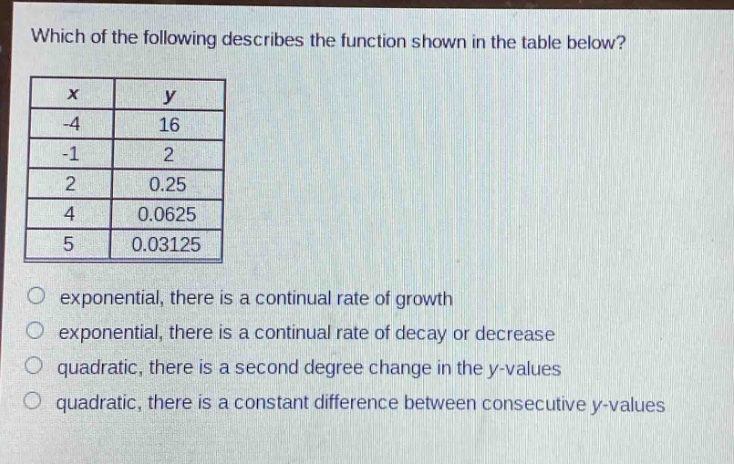
which of the following describes the function shown in the table below?\n| x | y |\n| -4 | 16 |\n| -1 | 2 |\n| 2 | 0.25 |\n| 4 | 0.0625 |\n| 5 | 0.03125 |\no exponential, there is a continual rate of growth\no exponential, there is a continual rate of decay or decrease\no quadratic, there is a second degree change in the y - values\no quadratic, there is a constant difference between consecutive y - values
Answer
Explanation:
Step1: Check for exponential - ratio of y - values
Let's find the ratio of consecutive y - values. For (x=-4,y = 16) and (x=-1,y = 2). The ratio is (\frac{2}{16}=\frac{1}{8}). For (x=-1,y = 2) and (x = 2,y=0.25), the ratio is (\frac{0.25}{2}=\frac{1}{8}). For (x = 2,y=0.25) and (x = 4,y = 0.0625), the ratio is (\frac{0.0625}{0.25}=\frac{1}{4}). Since (\frac{1}{4}=(\frac{1}{2})^2) and (\frac{1}{8}=(\frac{1}{2})^3), the general form of an exponential function (y = a\cdot b^x) is applicable here with (b=\frac{1}{2}<1).
Step2: Determine the type of exponential function
Since the base (b=\frac{1}{2}<1) in the exponential function (y=a\cdot b^x), the function represents exponential decay.
Answer:
exponential, there is a continual rate of decay or decrease