which of the following describes the graph of $y = sqrt{-4x - 36}$ compared to the parent square root…
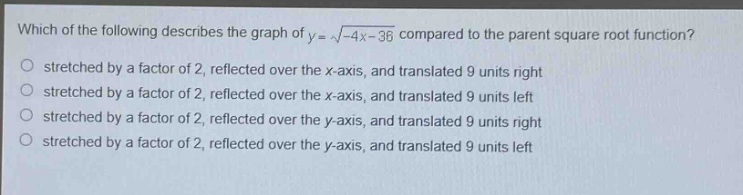
which of the following describes the graph of $y = sqrt{-4x - 36}$ compared to the parent square root function?\nstretched by a factor of 2, reflected over the x - axis, and translated 9 units right\nstretched by a factor of 2, reflected over the x - axis, and translated 9 units left\nstretched by a factor of 2, reflected over the y - axis, and translated 9 units right\nstretched by a factor of 2, reflected over the y - axis, and translated 9 units left
Answer
Explanation:
Step1: Rewrite the function
The parent square - root function is $y = \sqrt{x}$. Given $y=\sqrt{-4x - 36}=\sqrt{-4(x + 9)}$. First, consider the general form of a transformed square - root function $y = a\sqrt{b(x - h)}+k$. Here, $k = 0$.
Step2: Analyze the coefficient of $x$
For the horizontal stretch/compression and reflection, the coefficient of $x$ is $b=-4$. The absolute value of $b$, $|b| = 4$. Since $y=\sqrt{-4x - 36}=\sqrt{-4(x + 9)}$, we can rewrite it as $y = 2\sqrt{- (x+9)}$ (because $\sqrt{4}=2$). The negative sign in front of $x$ inside the square - root reflects the graph over the $y$ - axis. The factor of $2$ in front of the square - root stretches the graph vertically by a factor of 2.
Step3: Analyze the horizontal translation
The value of $h=-9$ in the form $y = 2\sqrt{-(x - h)}$. According to the rule of horizontal translation for the function $y=\sqrt{x - h}$, when $h=-9$, the graph is translated 9 units to the left.
Answer:
stretched by a factor of 2, reflected over the y - axis, and translated 9 units left