which of the following describes the zeroes of the graph of $f(x)=-x^{5}+9x^{4}-18x^{3}$?\n0 with…
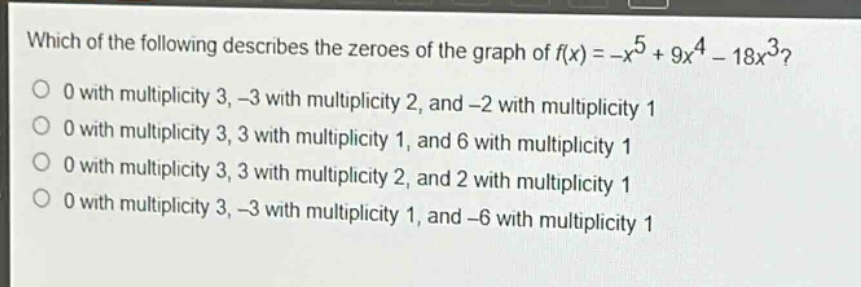
which of the following describes the zeroes of the graph of $f(x)=-x^{5}+9x^{4}-18x^{3}$?\n0 with multiplicity 3, -3 with multiplicity 2, and -2 with multiplicity 1\n0 with multiplicity 3, 3 with multiplicity 1, and 6 with multiplicity 1\n0 with multiplicity 3, 3 with multiplicity 2, and 2 with multiplicity 1\n0 with multiplicity 3, -3 with multiplicity 1, and -6 with multiplicity 1
Answer
Explanation:
Step1: Factor the polynomial
First, factor out the greatest - common factor $-x^{3}$ from $f(x)=-x^{5}+9x^{4}-18x^{3}$. We get $f(x)=-x^{3}(x^{2} - 9x + 18)$.
Step2: Factor the quadratic part
Factor the quadratic expression $x^{2}-9x + 18$. We need to find two numbers that multiply to $18$ and add up to $9$. The numbers are $6$ and $3$, so $x^{2}-9x + 18=(x - 3)(x - 6)$.
Step3: Find the zeros
Set $f(x)=0$. Then $-x^{3}(x - 3)(x - 6)=0$. Using the zero - product property, if $ab = 0$, then $a = 0$ or $b = 0$. For $-x^{3}=0$, $x = 0$ with multiplicity $3$ (because of the exponent $3$ on $x$). For $x - 3=0$, $x = 3$ with multiplicity $1$. For $x - 6=0$, $x = 6$ with multiplicity $1$.
Answer:
0 with multiplicity 3, 3 with multiplicity 1, and 6 with multiplicity 1