which of the following is an extraneous solution of $(45 - 3x)^{\frac{1}{2}}=x - 9$?\n$x=-12$\n$x = - 3$\n$x…
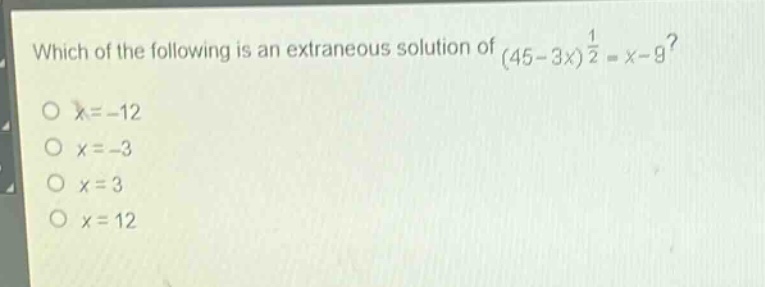
which of the following is an extraneous solution of $(45 - 3x)^{\frac{1}{2}}=x - 9$?\n$x=-12$\n$x = - 3$\n$x = 3$\n$x = 12$
Answer
Answer:
C. $x = 3$
Explanation:
Step1: Rewrite the equation
The given equation is $(45 - 3x)^{\frac{1}{2}}=x - 9$. Since $(45 - 3x)^{\frac{1}{2}}=\sqrt{45 - 3x}$, we have $\sqrt{45 - 3x}=x - 9$. The domain of the left - hand side requires $45-3x\geq0$, or $x\leq15$. Also, for the right - hand side, since the square root is non - negative, $x - 9\geq0$, so $x\geq9$.
Step2: Square both sides
Squaring both sides of $\sqrt{45 - 3x}=x - 9$, we get $45-3x=(x - 9)^2$. Expand the right - hand side: $(x - 9)^2=x^{2}-18x + 81$. So the equation becomes $45-3x=x^{2}-18x + 81$.
Step3: Rearrange to a quadratic equation
Rearrange the equation $45-3x=x^{2}-18x + 81$ to the standard quadratic form $ax^{2}+bx + c = 0$. We have $x^{2}-18x+3x + 81 - 45=0$, which simplifies to $x^{2}-15x + 36=0$.
Step4: Solve the quadratic equation
Use the quadratic formula $x=\frac{-b\pm\sqrt{b^{2}-4ac}}{2a}$ for the quadratic equation $x^{2}-15x + 36=0$, where $a = 1$, $b=-15$, and $c = 36$. First, calculate the discriminant $\Delta=b^{2}-4ac=(-15)^{2}-4\times1\times36=225 - 144 = 81$. Then $x=\frac{15\pm\sqrt{81}}{2}=\frac{15\pm9}{2}$. We get two solutions: $x_1=\frac{15 + 9}{2}=12$ and $x_2=\frac{15 - 9}{2}=3$.
Step5: Check the solutions
For $x = 12$: Left - hand side: $\sqrt{45-3\times12}=\sqrt{45 - 36}=\sqrt{9}=3$. Right - hand side: $12-9 = 3$. So $x = 12$ is a valid solution. For $x = 3$: Left - hand side: $\sqrt{45-3\times3}=\sqrt{45 - 9}=\sqrt{36}=6$. Right - hand side: $3-9=-6$. Since $\sqrt{45 - 3x}\geq0$ and when $x = 3$, the left - hand side is 6 and the right - hand side is - 6, $x = 3$ is an extraneous solution.