which of the following is an extraneous solution of $sqrt{-3x - 2}=x + 2$?\n$x=-6$\n$x=-1$\n$x = 1$\n$x = 6$
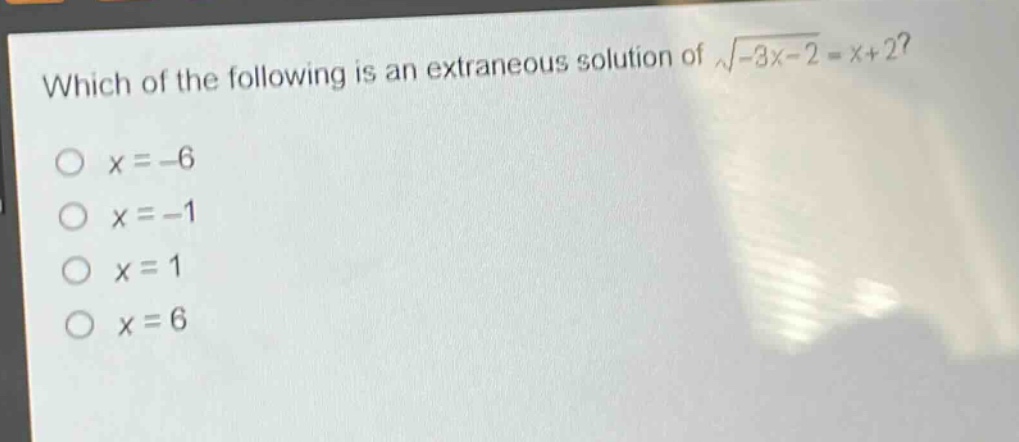
which of the following is an extraneous solution of $sqrt{-3x - 2}=x + 2$?\n$x=-6$\n$x=-1$\n$x = 1$\n$x = 6$
Answer
Explanation:
Step1: Square both sides
Square the equation $\sqrt{-3x - 2}=x + 2$. We get $-3x-2=(x + 2)^2$.
Step2: Expand the right - hand side
Expand $(x + 2)^2$ using the formula $(a + b)^2=a^{2}+2ab + b^{2}$. So $(x + 2)^2=x^{2}+4x+4$. Then the equation becomes $-3x-2=x^{2}+4x + 4$.
Step3: Rearrange to a quadratic equation
Rearrange the terms to get a quadratic equation in standard form $ax^{2}+bx + c = 0$. So $x^{2}+4x+3x+4 + 2=0$, which simplifies to $x^{2}+7x+6=0$.
Step4: Factor the quadratic equation
Factor $x^{2}+7x + 6$ as $(x + 6)(x+1)=0$.
Step5: Solve for x
Set each factor equal to zero: $x+6 = 0$ gives $x=-6$ and $x + 1=0$ gives $x=-1$.
Step6: Check for extraneous solutions
For $x=-6$, $\sqrt{-3(-6)-2}=\sqrt{18 - 2}=\sqrt{16}=4$, and $-6 + 2=-4$. Since $4\neq-4$, $x=-6$ is an extraneous solution. For $x=-1$, $\sqrt{-3(-1)-2}=\sqrt{3 - 2}=1$, and $-1 + 2=1$. Since $1 = 1$, $x=-1$ is a valid solution.
Answer:
A. $x=-6$