the following figure is a rectangle made up of two smaller rectangles.\n(a) find the area of the following…
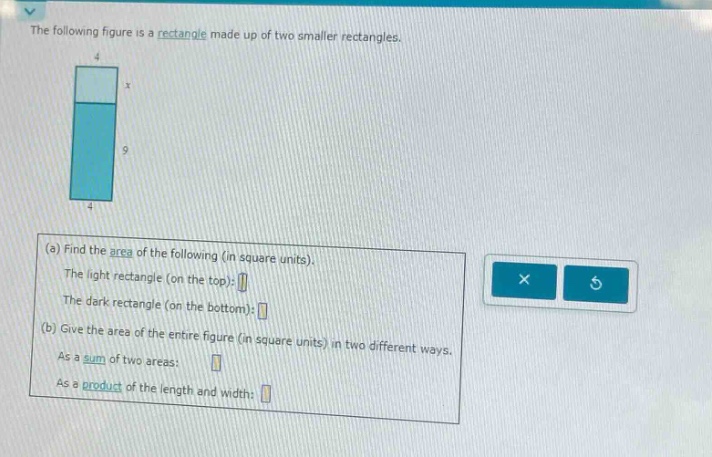
the following figure is a rectangle made up of two smaller rectangles.\n(a) find the area of the following (in square units).\nthe light rectangle (on the top): \nthe dark rectangle (on the bottom): \n(b) give the area of the entire figure (in square units) in two different ways.\nas a sum of two areas: \nas a product of the length and width:
Answer
Explanation:
Step1: Find area of top - light rectangle
The area formula for a rectangle is $A = l\times w$. For the top - light rectangle, length $l = 4$ and width $w=x$. So the area $A_1=4\times x = 4x$.
Step2: Find area of bottom - dark rectangle
For the bottom - dark rectangle, length $l = 4$ and width $w = 9$. So the area $A_2=4\times9=36$.
Step3: Find area as a sum
The area of the entire figure as a sum of the two areas is $A=A_1 + A_2=4x + 36$.
Step4: Find area as a product
The length of the entire rectangle is $x + 9$ and the width is 4. So the area as a product of length and width is $A=4\times(x + 9)=4(x + 9)$.
Answer:
(a) The light rectangle (on the top): $4x$; The dark rectangle (on the bottom): $36$ (b) As a sum of two areas: $4x+36$; As a product of the length and width: $4(x + 9)$