which of the following could be the function graphed?\n$f(x)=\frac{8x^{2}}{x^{2}-9}$\n$f(x)=\frac{119x}{792x…
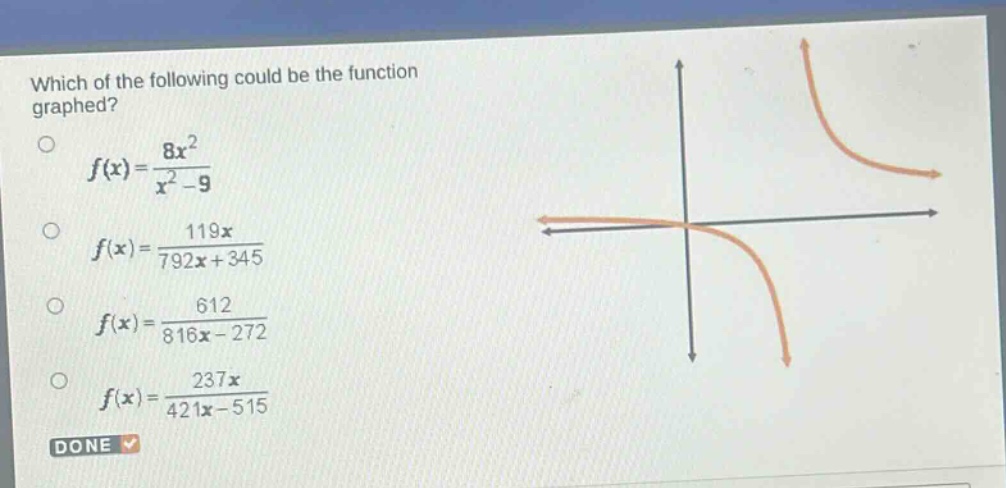
which of the following could be the function graphed?\n$f(x)=\frac{8x^{2}}{x^{2}-9}$\n$f(x)=\frac{119x}{792x + 345}$\n$f(x)=\frac{612}{816x - 272}$\n$f(x)=\frac{237x}{421x - 515}$\ndone
Answer
Answer:
A. $f(x)=\frac{8x^{2}}{x^{2}-9}$
Explanation:
Step1: Analyze vertical asymptotes
Vertical asymptotes occur when denominator is 0. For $y = \frac{8x^{2}}{x^{2}-9}=\frac{8x^{2}}{(x + 3)(x - 3)}$, vertical - asymptotes are $x=3$ and $x = - 3$. Other functions have single vertical asymptotes.
Step2: Analyze horizontal asymptotes
For $y=\frac{8x^{2}}{x^{2}-9}$, as $x\to\pm\infty$, $y=\frac{8x^{2}}{x^{2}(1-\frac{9}{x^{2}})}\to8$. Rational functions of form $\frac{ax}{bx + c}$ have horizontal asymptote $y=\frac{a}{b}$, and $\frac{c}{bx + d}$ have horizontal asymptote $y = 0$. So this function's asymptote behavior matches the graph.