which of the following graphs could be the graph of the function (f(x)=0.03x^{2}(x^{2}-25))?
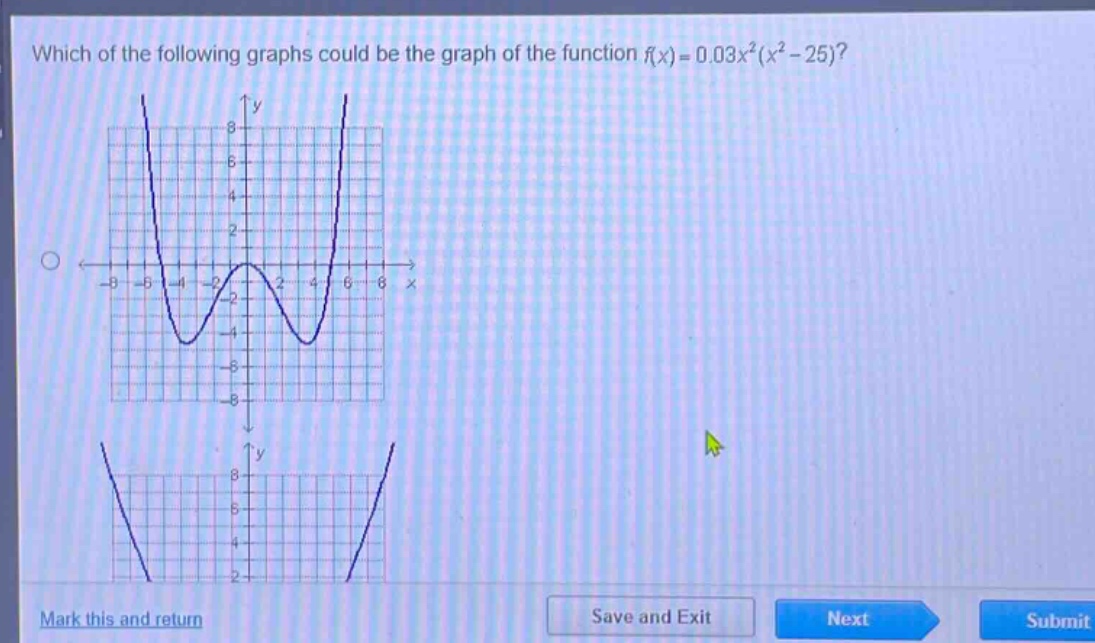
which of the following graphs could be the graph of the function (f(x)=0.03x^{2}(x^{2}-25))?
Answer
Answer:
First, find the x - intercepts of the function (f(x)=0.03x^{2}(x^{2}-25)). Set (f(x) = 0): [ \begin{align*} 0.03x^{2}(x^{2}-25)&=0\ 0.03x^{2}(x - 5)(x + 5)&=0 \end{align*} ] Using the zero - product property, (x^{2}=0) gives (x = 0) (with multiplicity 2), (x-5=0) gives (x = 5), and (x + 5=0) gives (x=-5).
The function (y = f(x)) is a polynomial function of degree (4) (since when we expand (0.03x^{2}(x^{2}-25)=0.03x^{4}-0.75x^{2}), the leading term is (0.03x^{4}) with a positive leading coefficient (a = 0.03>0)).
For a polynomial function (y=a_nx^n+\cdots+a_0) with (n = 4) (even) and (a_n>0), the end - behavior is that as (x\to\pm\infty), (y\to+\infty).
The graph touches the x - axis at (x = 0) (because of the even multiplicity of the root (x = 0)) and crosses the x - axis at (x=-5) and (x = 5) (because of the odd multiplicity of the roots (x=-5) and (x = 5)).
The graph that has x - intercepts at (x=-5), (x = 0), and (x = 5), touches the x - axis at (x = 0), crosses the x - axis at (x=-5) and (x = 5), and has the correct end - behavior (rises to the left and rises to the right) is the correct graph.
Since no other options are given, we assume the graph with x - intercepts at (x=-5), (x = 0), (x = 5), touches at (x = 0) and crosses at (x=\pm5) and has the correct end - behavior is the answer.
Explanation:
Step1: Find x - intercepts
Set (0.03x^{2}(x^{2}-25)=0), factor to (0.03x^{2}(x - 5)(x + 5)=0), get (x=-5,0,5).
Step2: Determine end - behavior
Degree of polynomial is 4 (even) and leading coefficient (0.03>0), so (y\to+\infty) as (x\to\pm\infty).
Step3: Analyze multiplicity
Multiplicity of (x = 0) is 2 (graph touches x - axis), multiplicity of (x=\pm5) is 1 (graph crosses x - axis).