which of the following is an odd function?\n$f(x)=3x^{2}+x$\n$f(x)=4x^{3}+7$\n$f(x)=5x^{2}+9$\n$f(x)=6x^{3}+2…
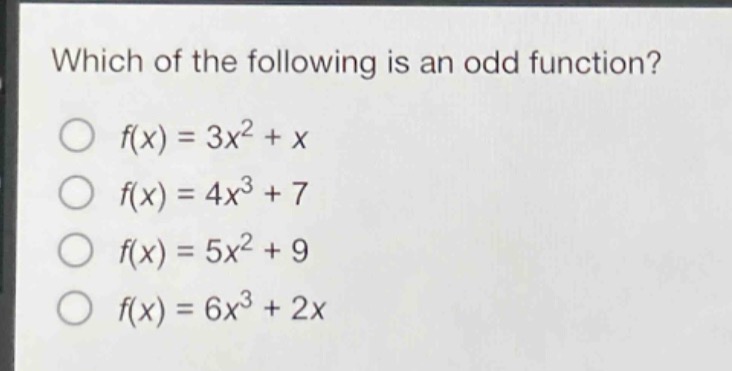
which of the following is an odd function?\n$f(x)=3x^{2}+x$\n$f(x)=4x^{3}+7$\n$f(x)=5x^{2}+9$\n$f(x)=6x^{3}+2x$
Answer
Explanation:
Step1: Recall odd - function definition
A function (y = f(x)) is odd if (f(-x)=-f(x)) for all (x) in the domain of (f).
Step2: Check (f(x)=3x^{2}+x)
[ \begin{align*} f(-x)&=3(-x)^{2}+(-x)\ &=3x^{2}-x \end{align*} ] (-f(x)=-(3x^{2}+x)= - 3x^{2}-x), (f(-x)\neq - f(x)).
Step3: Check (f(x)=4x^{3}+7)
[ \begin{align*} f(-x)&=4(-x)^{3}+7\ &=-4x^{3}+7 \end{align*} ] (-f(x)=-(4x^{3}+7)=-4x^{3}-7), (f(-x)\neq - f(x)).
Step4: Check (f(x)=5x^{2}+9)
[ \begin{align*} f(-x)&=5(-x)^{2}+9\ &=5x^{2}+9 \end{align*} ] (-f(x)=-(5x^{2}+9)=-5x^{2}-9), (f(-x)\neq - f(x)).
Step5: Check (f(x)=6x^{3}+2x)
[ \begin{align*} f(-x)&=6(-x)^{3}+2(-x)\ &=-6x^{3}-2x\ &=-(6x^{3}+2x)\ &=-f(x) \end{align*} ]
Answer:
(f(x) = 6x^{3}+2x)