which of the following is an odd function?\no (g(x)=x^{2})\no (g(x)=5x - 1)\no (g(x)=3)\no (g(x)=4x)
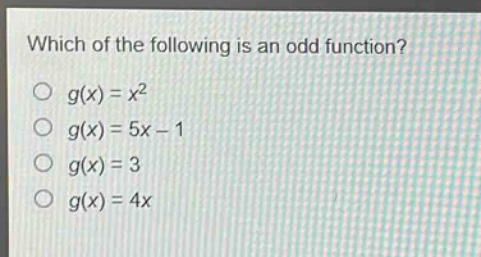
which of the following is an odd function?\no (g(x)=x^{2})\no (g(x)=5x - 1)\no (g(x)=3)\no (g(x)=4x)
Answer
Explanation:
Step1: Definición de función impar
Una función (y = g(x)) es impar si (g(-x)=-g(x)) para todos los valores de (x) en el dominio de (g).
Step2: Analizar (g(x)=x^{2})
Sustituimos (-x) en (g(x)): (g(-x)=(-x)^{2}=x^{2}), y (-g(x)=-x^{2}). Como (g(-x)\neq -g(x)), no es impar.
Step3: Analizar (g(x)=5x - 1)
Sustituimos (-x): (g(-x)=5(-x)-1=-5x - 1), y (-g(x)=-(5x - 1)=-5x + 1). Como (g(-x)\neq -g(x)), no es impar.
Step4: Analizar (g(x)=3)
Sustituimos (-x): (g(-x)=3), y (-g(x)=-3). Como (g(-x)\neq -g(x)), no es impar.
Step5: Analizar (g(x)=4x)
Sustituimos (-x): (g(-x)=4(-x)=-4x), y (-g(x)=-(4x)=-4x). Como (g(-x)=-g(x)), es impar.
Answer:
(g(x) = 4x)