which of the following is an odd function?\no (f(x)=x^{3}+5x^{2}+x)\no (f(x)=sqrt{x})\no (f(x)=x^{2}+x)\no…
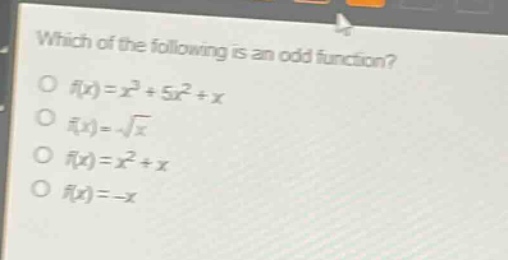
which of the following is an odd function?\no (f(x)=x^{3}+5x^{2}+x)\no (f(x)=sqrt{x})\no (f(x)=x^{2}+x)\no (f(x)=-x)
Answer
Explanation:
Step1: Recall odd - function definition
A function $f(x)$ is odd if $f(-x)=-f(x)$ for all $x$ in the domain of $f$.
Step2: Check $f(x)=x^{3}+5x^{2}+x$
$f(-x)=(-x)^{3}+5(-x)^{2}+(-x)=-x^{3}+5x^{2}-x$. And $-f(x)=-(x^{3}+5x^{2}+x)=-x^{3}-5x^{2}-x$. Since $f(-x)\neq -f(x)$, it is not an odd - function.
Step3: Check $f(x)=\sqrt{x}$
The domain of $y = \sqrt{x}$ is $x\geq0$. The concept of odd or even functions is defined for functions whose domain is symmetric about the origin. Since the domain of $y=\sqrt{x}$ is not symmetric about the origin, it is not an odd function.
Step4: Check $f(x)=x^{2}+x$
$f(-x)=(-x)^{2}+(-x)=x^{2}-x$. And $-f(x)=-(x^{2}+x)=-x^{2}-x$. Since $f(-x)\neq -f(x)$, it is not an odd - function.
Step5: Check $f(x)=-x$
$f(-x)=-(-x)=x$. And $-f(x)=-(-x)=x$. Since $f(-x)=-f(x)$, it is an odd function.
Answer:
$f(x)=-x$