which of the following is a radical equation?\n$x\\sqrt{3}=13$\n$x + \\sqrt{3}=13$\n$\\sqrt{x}+3 = 13$\n$x +…
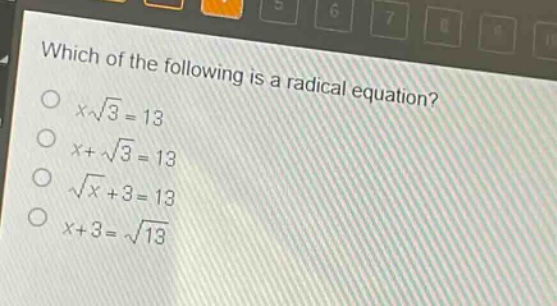
which of the following is a radical equation?\n$x\\sqrt{3}=13$\n$x + \\sqrt{3}=13$\n$\\sqrt{x}+3 = 13$\n$x + 3=\\sqrt{13}$
Answer
Explanation:
Step1: Recall radical - equation definition
A radical equation is an equation in which a variable is under a radical sign.
Step2: Analyze each option
- For $x\sqrt{3}=13$, the variable $x$ is not under the radical sign, $\sqrt{3}$ is a constant.
- For $x + \sqrt{3}=13$, the variable $x$ is not under the radical sign, $\sqrt{3}$ is a constant.
- For $\sqrt{x}+3 = 13$, the variable $x$ is under the square - root radical sign.
- For $x + 3=\sqrt{13}$, the variable $x$ is not under the radical sign, $\sqrt{13}$ is a constant.
Answer:
$\sqrt{x}+3 = 13$