8. which of the following statements is not true? f credit card companies charge a late fee when you fail to…
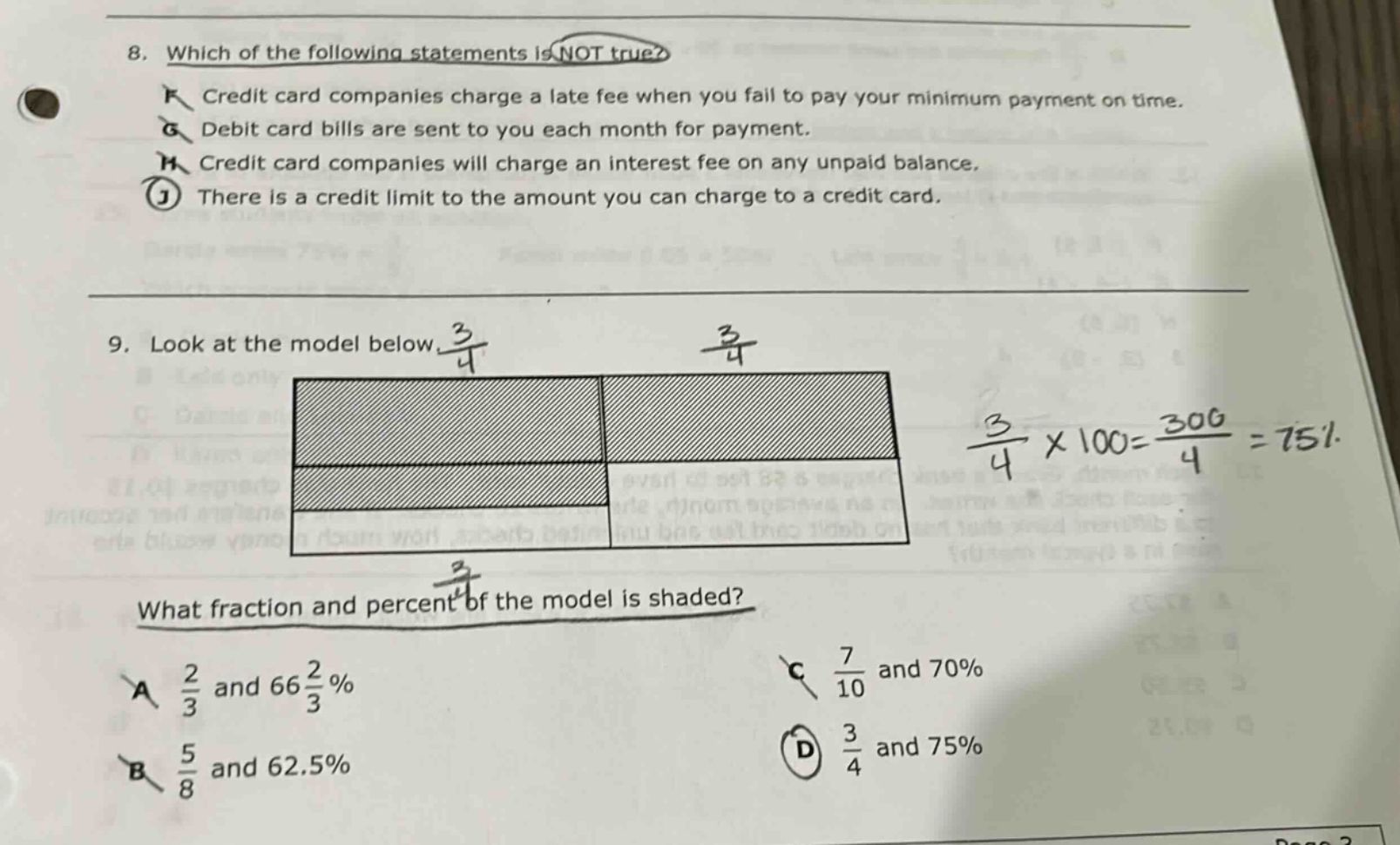
8. which of the following statements is not true? f credit card companies charge a late fee when you fail to pay your minimum payment on time. g debit card bills are sent to you each month for payment. h credit card companies will charge an interest fee on any unpaid balance. j there is a credit limit to the amount you can charge to a credit card. 9. look at the model below. what fraction and percent of the model is shaded? a 2/3 and 66 2/3% b 5/8 and 62.5% c 7/10 and 70% d 3/4 and 75%
Answer
8.
Brief Explanations:
Debit cards draw directly from a bank account, so there are no monthly bills for payment like credit - cards. Credit card companies do charge late fees for missed minimum payments, interest on unpaid balances, and there is a credit limit.
Answer:
G. Debit card bills are sent to you each month for payment.
9.
Explanation:
Step1: Identify the fraction
The shaded part is clearly labeled as $\frac{3}{4}$ in the model.
Step2: Convert fraction to percent
To convert $\frac{3}{4}$ to a percent, we use the formula $\text{Percent}=\frac{3}{4}\times100$. So, $\frac{3}{4}\times100=\frac{3\times100}{4}= 75%$.
Answer:
D. $\frac{3}{4}$ and $75%$