what is the following sum?\n4(\\sqrt5{x^{2}y}) + 3(\\sqrt5{x^{2}y})\n\\(7(\\sqrt10{x^{2}y})\\)\n\\(7(\\sqrt10…
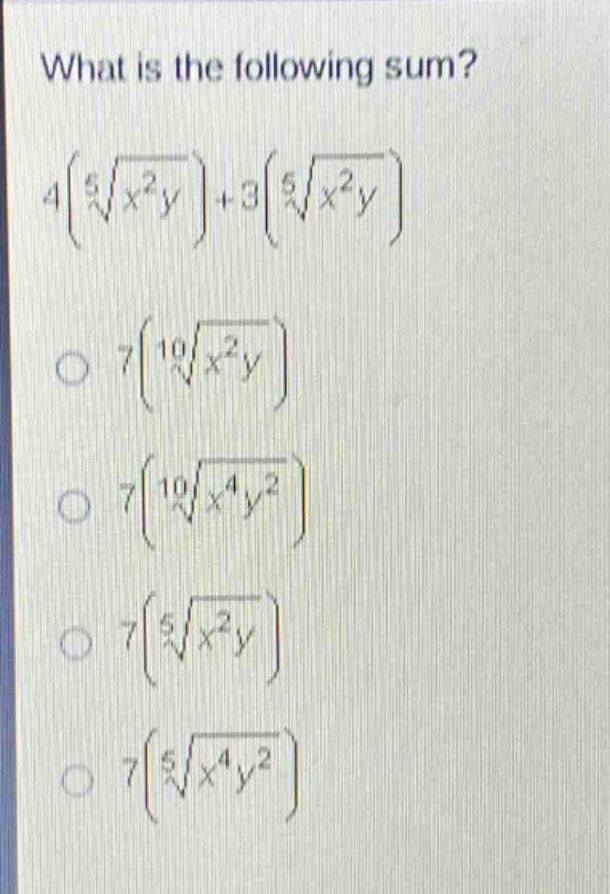
what is the following sum?\n4(\\sqrt5{x^{2}y}) + 3(\\sqrt5{x^{2}y})\n\\(7(\\sqrt10{x^{2}y})\\)\n\\(7(\\sqrt10{x^{4}y^{2}})\\)\n\\(7(\\sqrt5{x^{2}y})\\)\n\\(7(\\sqrt5{x^{4}y^{2}})\\)
Answer
Explanation:
Step1: Combine like - terms
The terms $4(\sqrt[5]{x^{2}y})$ and $3(\sqrt[5]{x^{2}y})$ are like - terms. When we add like - terms with the same radical part, we add the coefficients. The general rule for adding like terms $a\sqrt[n]{m}+b\sqrt[n]{m}=(a + b)\sqrt[n]{m}$. Here, $a = 4$, $b = 3$, and $\sqrt[n]{m}=\sqrt[5]{x^{2}y}$. $4(\sqrt[5]{x^{2}y})+3(\sqrt[5]{x^{2}y})=(4 + 3)\sqrt[5]{x^{2}y}$
Step2: Calculate the sum of the coefficients
$4+3 = 7$. So, $(4 + 3)\sqrt[5]{x^{2}y}=7\sqrt[5]{x^{2}y}$
Answer:
$7\left(\sqrt[5]{x^{2}y}\right)$