which of the following is true about the base b of a logarithmic function?\no b > 0 and b = 1\no b > 0 and…
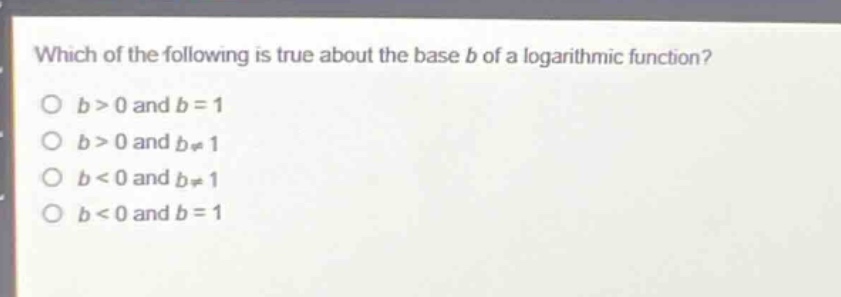
which of the following is true about the base b of a logarithmic function?\no b > 0 and b = 1\no b > 0 and b≠1\no b < 0 and b≠1\no b < 0 and b = 1
Answer
Answer:
b > 0 and b ≠ 1
Explanation:
Step1: Recall logarithm definition
The logarithm function (y = \log_{b}x) is defined for (b>0) and (b\neq1). If (b = 1), (\log_{1}x) is undefined because (1^{y}=x) has no unique solution for (x\neq1) and is not well - behaved. If (b<0), (\log_{b}x) will lead to complex - valued results for many real - valued (x) values and is not considered in the standard real - valued logarithm function. So the base (b) of a logarithmic function must satisfy (b > 0) and (b\neq1).